Wheel of Life (Balance Wheel)
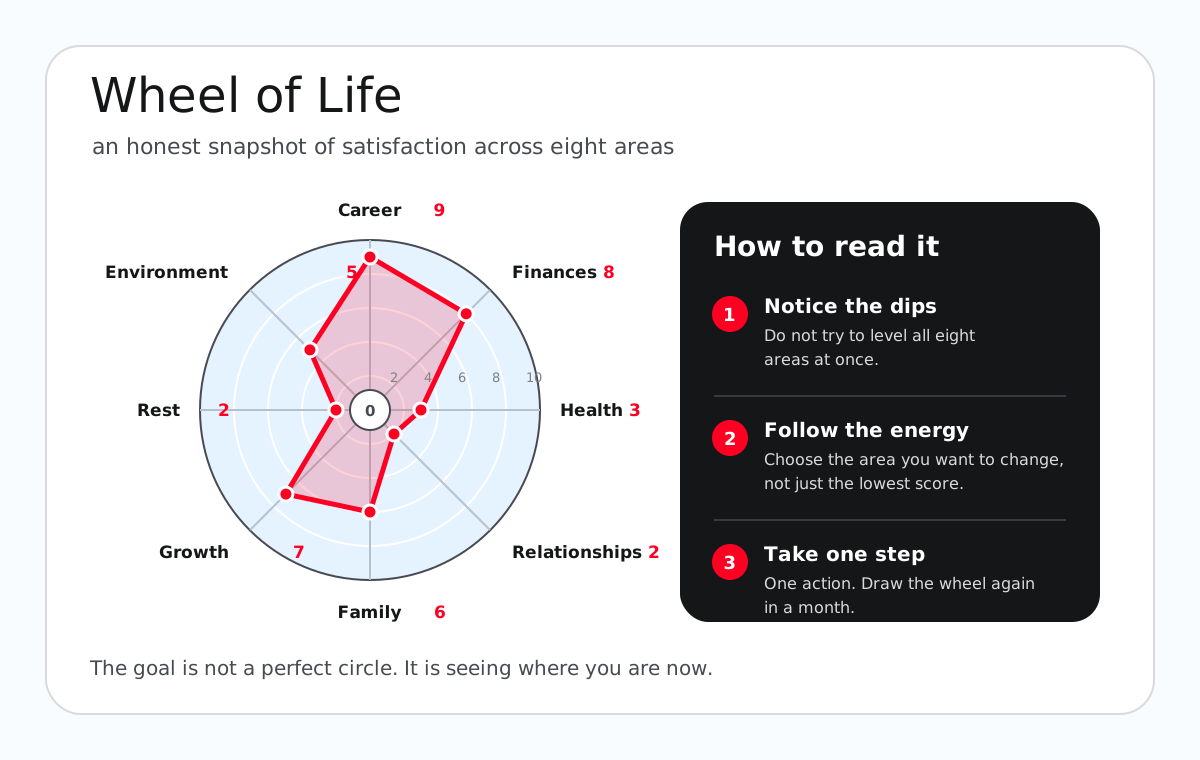
The wheel of life is a visual self-assessment tool: life is divided into 6-8 areas, each is rated from 0 to 10 by how satisfied you are with it, and the result is drawn as a circle - to see where it “sags.” Its purpose is not to make you perfect, but to untangle the knot of “everything is mixed up” and to see where it is empty right now, and where it is out of balance.
A familiar feeling: the year has passed, but the sense that it was actually lived is missing. A lot of energy goes out, and it is unclear where. Or “everything seems fine, and yet I don’t want anything.” In such moments it is hard to tell where exactly the hole is, because everything is tangled into one knot. The wheel of life is a simple map for untangling that knot.
Who invented the wheel of life
The wheel of life was invented by Paul J. Meyer in the 1960s (Success Motivation Institute, USA) under the name “Balance Wheel.” Later Whitworth and co-authors (the book “Co-Active Coaching,” 1998) formalized it as the Wheel of Life Scale - a scale used in coaching that has passed psychometric validation. Today the tool is part of the basic toolkit of the ICF (International Coaching Federation).
What areas make up the wheel of life
The typical 8 areas (they can and should be adjusted to fit you - this matters for the section about limits):
- Career / work
- Finances
- Health and body
- Relationships (partner, close people)
- Family
- Personal growth / learning
- Rest and recovery
- Physical environment (home, surroundings)
Here is how it looks on a living person. Finances at 8, health at 3 - and the person honestly cannot understand where the burnout came from. On paper everything is fine, they are “successful.” But the wheel shows the gap that the body has known about for a long time, while the head refused to see it.
Or the opposite story: career at 9, relationships at 2. A person closes the year with the best numbers of their life and sits with this achievement completely alone - and cannot understand why success tastes like cardboard. The wheel does not explain why, but for the first time it makes this “why” visible: here is where it is full, and here is where it is empty.
How the wheel of life works
The value of the wheel is not in the numbers and not in the shape of the circle, but in the moment of an honest answer. When a person stops and says out loud “rest - right now it’s 2 out of 10,” something shifts even before they do anything about it. Naming it is already half the work.
The wheel of life is not a diagnosis and not an order to “fix the balance immediately.” It is a snapshot: this is the person right now. What comes next is separate work, and it is not necessarily about “pushing every area to 10.”
Where to use the wheel of life
The wheel of life is useful in several situations:
- At the start of a year or a quarter - as a planning point.
- Before a big decision (moving, changing jobs, launching something) - so a new project does not land on top of areas that have already sagged. A classic: a person launches a second business on top of health at 3 - and is surprised to collapse half a year later.
- In burnout - it often becomes visible that one area has eaten three others.
- When “everything at once” has piled up - the wheel brings the scale back: eight areas cannot be lifted at the same time, one or two can.
- When a person does not know what they want - sometimes it is easier to first see what they are unhappy with.
Where the wheel of life does not work
The wheel of life has three limits, and they are rarely talked about honestly.
First: the ready-made 8 areas are someone else’s ontology. If a person has no “family” in the classic sense, or no “career” as such, they either cross the item out or squeeze themselves into someone else’s boxes. A living example: a freelancer with no “career ladder” at all gives themselves a 3 in “career” and gets upset - although they live in a different coordinate system, where there is no ladder and none is needed. Or a person who consciously chose life without a family sees the empty “family” box and feels deficient by someone else’s template. The areas must be your own.
Second: the 0-10 scale is subjective and drifts. Today “work - 7,” tomorrow, after one bad meeting, - 3. This is normal: the wheel is for a snapshot, not for measurement.
Third: the wheel is easy to “repaint” with self-deception. And the trickiest case is not when the numbers get inflated, but when the circle comes out even. A person draws 6-7 everywhere, admires the even wheel and feels good about themselves. In fact they have simply lowered the bar in all areas at once: nothing is bad, because they no longer want anything anywhere. An even circle is sometimes not a sign of harmony, but a sign that a person has quietly given up on themselves. The tool does not protect from this - only honesty does.
The connection with Spheres of Life: the wheel of life is a flat entry snapshot. “Spheres of Life” is already a 3D map: not “how satisfied am I,” but “who is near me, what scale am I looking at, what is really in my hands.” The wheel answers “where am I now,” the spheres answer “where to look.”
How people work with the wheel of life
It goes like this. The areas are taken as your own, not from a ready template - the picture is more precise that way. The rating is given by the first honest reaction, not by “how it should be.” Then no attempt to even everything out at once: the wheel is not there to become round.
But choosing the area for action - here is a subtle point that usually gets missed. You take not the worst area by its number, but the one where there is inner energy to change something. An example: a person has “physical environment” at 3 - a rented, uncomfortable apartment - but honestly, they don’t care, they only sleep there. And “personal growth” is at 6, and that is where it burns: they have long wanted to study, their hands are itching. The logic of numbers says “fix the apartment.” The logic of energy says “go into growth.” You listen to the second one - because that is where the fuel is, and in an area without fuel any action dies within a week. Choose one or two areas, take one concrete action, redraw the wheel in a month or a quarter and compare.
The wheel of life in AI agent design
The main idea of the wheel - the strength of a system is not the maximum of one axis but the absence of holes - works for an agent too. An agent has its own “areas”: speed, accuracy, cost, safety, autonomy, transparency. The temptation is to push one of them to 10. But an agent with autonomy at 10 and transparency at 2 is not a strong agent - it is the one who will one day quietly do the wrong thing and leave no trace to understand why. Sounds familiar: it is the same person with career at 9 and relationships at 2 - brilliant in one thing and empty exactly where it will explode later. The wheel forces you to look at the whole circle, not at your favorite axis.
The second turn: the agent itself as a mirror for the wheel. An agent that once a month asks a person five short questions about their areas notices the drift where the person no longer sees it: “health was 6, now it is 3 - and it has been like this for two months. Shall we talk about it?” Not a diagnosis and not a “go fix yourself” plan - one precise question at the right moment. Which is exactly what the wheel itself does: it returns an honest snapshot, not a progress report.
And the third, most sobering principle - “don’t chase the even circle.” In agent-building it cures the main disease: the desire to optimize everything at once. The agent does not need to reach 10 on every metric - the point is to find the one or two areas where the leverage is right now, and leave the rest alone. The wheel of life, in essence, tells the engineer the same thing it tells a tired person: becoming round is impossible, and unnecessary.
Frequently asked questions about the wheel of life
How many areas should the wheel of life have? Usually 6-8, but the number and the names of the areas are better taken as your own, not from a ready template - someone else’s ontology distorts the picture.
Is the wheel of life the same as the “balance wheel”? Yes. The Wheel of Life Scale is the formalized coaching version of the same tool that Paul J. Meyer introduced as the “Balance Wheel.”
Should the goal be an even circle? No. The wheel of life is a snapshot of a state, not a goal to “make it even.” The task is to see the imbalance and choose one or two areas for action, not to level all eight.
How is the wheel of life different from the “Spheres of Life” model? The wheel of life gives a flat snapshot of “where am I now” by satisfaction. Spheres of Life is a 3D map by closeness, scale and agency, answering the question “where to look.”
How often should the wheel of life be redone? Once a month or a quarter: rarely enough to have something to compare, and often enough to notice the drift.
The wheel does not make life even. It simply shows where a person is standing right now - and standing on real ground is more comfortable than appearing even.