Spiral Dynamics
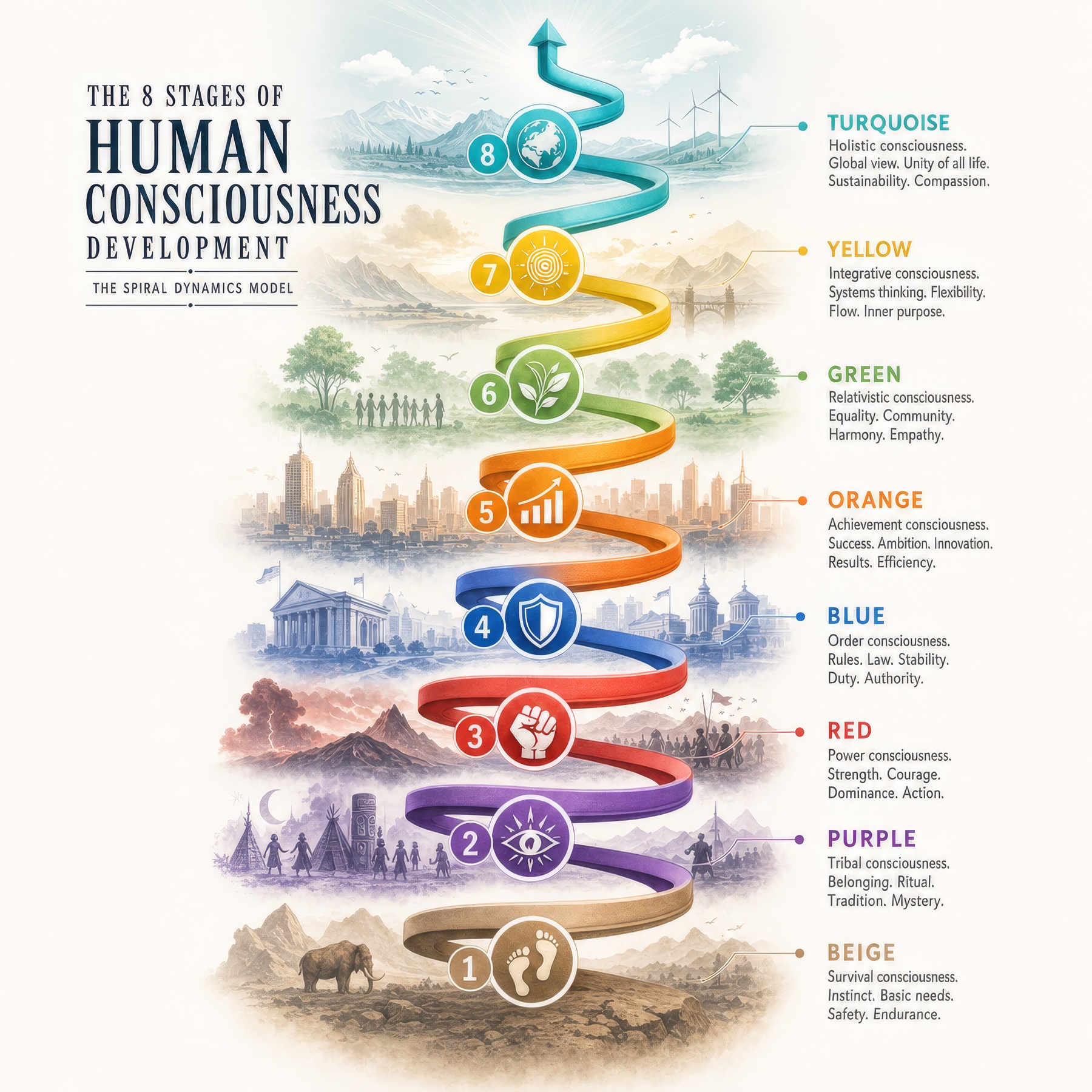
Spiral Dynamics is an integral model of the architecture of human consciousness that represents the leading edge of our understanding of the stages of development of a person and a society. It describes the step-by-step change of people’s value orientations as the complexity of their thinking grows. Spiral Dynamics is a practical tool for building highly effective organizations, for long-term planning in conditions of chaos, and for finding new inspiring meanings and ideas.
Graves’ Spiral Dynamics
Based on the materials of D. Beck and C. Cowan
The principles of Spiral Dynamics
Principle 1: People have the capacity to create new memes
The key point in Graves’ concept of Spiral Dynamics is that people have the inner capacity to exist at different levels of psychological development, and even to add new levels. These are not “better” or “worse” states - they simply reflect different views of what the world is and how complex it is. This is also supported by recent findings in neurological research.
According to them, the awakening of new functions of the brain/mind depends on three factors:
- Hereditary factors that make it possible to add, and even replace, old systems with new ones
- Dynamic forces generated by the environment and upbringing that “switch on” the corresponding systems
- The capacity of the human brain/mind to operate in several subsystems at once, some of which are active while others stay relatively passive
Principle 2: Memes awaken in response to changes in life conditions; as a result, memes will emerge, develop, or fade
Memes are the product of the interaction between the inner structure of our consciousness and the life conditions we face. The emergence of memes is not like stations where the train inevitably stops sooner or later. They are not something programmed into human biology. On the contrary, the dynamics of the Spiral are activated by the interaction between the inner state of consciousness and the outer world. If certain external conditions become regular or repetitive, the corresponding stereotypes of behavior and thinking appear. Otherwise they disappear.
There are four important aspects of these life conditions: Time, Place, Problems and Circumstances.
Historical Time: The position on the overall line of human development, the stage of development of a specific culture, the age phases of an individual’s life.
Key notions: Eras, generations, periods, cycles, dates, time frames, personal history, phases, the sense of past/present/future
At any moment of chronological Time, and in almost any community, you can find people living in the same year whose thinking is rooted in completely different eras. At any given moment of your life you live with a unique package of memes that developed in accordance with that Time and the culture surrounding it. For many people of Western culture the 1940s were very different from the 1950s, the 1960s, the 1990s or the 2000s. Yet for some Third World countries Time has remained practically unchanged for many generations.
When the flow of Time really does change external conditions, the stress awakens our inner resources to such a degree that in response we can add new memes (or reorganize old ones). This sequential layering of a person’s adapting ways of thinking is like the annual rings of a tree. Each ring reflects the surrounding conditions of one year. The change of “seasons” in a person’s life leaves rings in the meme system that show up in culture and psychosocial development. Who you are today, were yesterday and will be tomorrow is largely shaped by the conditions you meet at different stages of your life. We are not prisoners of our Time, but we are undoubtedly influenced by it.
Geographic Place: The physical conditions, the natural and man-made ecology in which an individual or a group lives.
Key notions: Atmospheric conditions, electromagnetic influences, natural surroundings (snow, desert, jungle, city, village), architecture, population density, the amount and character of external stimuli, the chemical and mineral composition of air, soil and food, sources and kinds of light, climate.
There are many factors in our geographic location that strongly influence our social values and interactions. Life on an isolated island produces kinds of collective behavior different from the behavior of a nomadic tribe, or of a culture that developed in a warm, fertile valley.
The factors of the geographic environment include everything from various natural influences (geomagnetic fields, topography, the sky, weather, seasons and so on) to the artificial environment - rooms, workplaces, buildings, cities and living space. This echoes the Chinese Feng Shui, which describes the process of harmonizing people with their surroundings. Ancient wisdom resonating with modern “discoveries.”
Human Problems: The priorities, needs, concerns and demands of existence that a specific individual or group faces; some are shared by all people, some are unique to a particular culture, social group or person.
Key notions: Survival problems such as food and water; the availability and richness/scarcity of social niches; perceived levels of threat or safety; cultural norms and demands; communications and languages; prevailing temperaments; heroes and anti-heroes; technologies; the social memory of the past; unresolved historical issues; images and legacies of the past; diseases and epidemics; social upheavals.
Such problems of existence trigger mechanisms in the human brain/mind that 1) allow the surrounding conditions to be perceived more precisely and 2) release physical and psychological resources to deal with them properly. Each basic meme of the Spiral is designed to solve its own unique set of problems. When several memes emerge at the same time in the same place, the level of conflict and turmoil rises accordingly. Many of today’s “hot spots” are heated not only by friction between different memes, but also by the problem of competition for limited resources.
Social Circumstances: The position of an individual, a group and a culture in the hierarchy of power, status and influence.
Key notions: Social roles; position in the flow of resources; socioeconomic class; level of education; opportunities and access to certain niches; appearance and physiognomy; relationship dynamics; political systems; lineage; national, age and gender factors.
No two people will ever be in the same Circumstances, even if they are in the same Place at the same Time solving similar Problems. Ways of life, social position, heredity, family privilege, intellectual or physical abilities, and simple luck will differ. The same applies to any given group or social layer. Whether we like it or not, these unequal life conditions have a significant influence on human life. No two people will perceive the surrounding world in the same way. Even twins will differ. Obviously, much of what happens in politics, religion and therapy is closely connected with this aspect of the Spiral.
Circumstances set boundaries for us - open or closed. They must be taken into account when interacting both with the “majority” and with “minorities,” with the successful and the unsuccessful. Circumstances can be a filter that keeps us from seeing the whole Spiral the way someone else might. Like the other three elements of life conditions, Circumstances also dictate which memes are most likely to be acceptable and justified in a given context. Disagreements about effective education systems, labor relations and living together are connected with different Circumstances.
To sum up the description of life conditions (Time, Place, Problems, Circumstances):
| …if life conditions are very… | …then “normal” people will… |
| Beige - natural | Behave like animals |
| Purple - mystical and incomprehensible | Placate the spirits and band together for safety |
| Red - harsh and dangerous, like the jungle | Fight for survival with no thought for others |
| Blue - guided by a higher power | Obey higher authority and keep faith with the Truth |
| Orange - full of practical opportunities | Pragmatically strive to win an advantage and succeed |
| Green - emphasizing what all people share | Join the community in order to grow together |
| Yellow - complex, threatening to collapse into chaos | Learn to stay free, yet also live by principles |
| Turquoise - like a single organism | Look for order in the apparent chaos on Earth |
A brief overview of the memes
The evolution of memes moves along several trajectories:
From a less complex To a more complex
natural, technological and social environment
From survival in the jungle To “surfing” the Internet and beyond
through the awakening of new ways of thinking and consciousness
From a small patch of land To the “global village” and cyberspace
through territorial and informational migration
First tier - the “subsistence memes”
The Beige meme - Survival - 1st Awakening
Basic theme: Do whatever it takes to stay alive
Characteristic beliefs and actions:
- Uses instincts and habits simply to survive
- The individual Self is barely present
- Priorities: Food, Water, Shelter, Sex and Safety
- Forms survival groups to prolong life
Where it is seen: primeval peoples, newborns, the frail elderly, the gravely ill, the homeless, starving masses.
The Purple meme - Mysticism - 2nd Awakening
Basic theme: Placate the spirits and keep the tribal “nest” warm and safe
Characteristic beliefs and actions:
- Obeys the wishes of the spirits and mystical signs
- Shows loyalty to the “chief,” the elders, the ancestors and the clan
- Guards sacred objects, places, events and memories
- Observes the rituals connected with the stages of life, the seasons and tribal customs
Where it is seen: Belief in guardian angels and curses, blood oaths, old feuds, trance chanting and dances, love charms, family rituals, mystical ethnic beliefs and superstitions. Strong in Third World countries, (criminal) gangs, sports teams and corporate “tribes.”
The Red meme - Impulse - 3rd Awakening
Basic theme: Be what you are and do what you want, regardless of anything
Characteristic beliefs and actions:
- The world is a jungle full of dangers and predators
- Breaks free from any domination or constraint in order to do whatever one pleases
- Rises above everyone, expects attention, demands respect and gives orders to all
- Enjoys life to the fullest right now - without guilt or remorse
- Conquers - by force or by cunning - and dominates other aggressive characters
Where it is seen: Selfish small children, rebellious teenagers, feudal kingdoms, epic heroes, rock stars, riot police, Picasso, Attila.
The Blue meme - Meaning - 4th Awakening
Basic theme: Life has meaning, direction and purpose, with predetermined outcomes
Characteristic beliefs and actions:
- A person sacrifices themselves for a transcendent Mission, Truth or righteous Path
- The Law prescribes rules of conduct based on eternal, absolute principles
- Righteous living gives stability in the present and guarantees reward in the future
- Impulsiveness is restrained by guilt; everyone has their place
- Laws, regulations and discipline build moral fiber and strength of character
Where it is seen: Billy Graham, Puritan America, Confucian China, Hasidic Judaism, the code of chivalry and honor, charity and good deeds, the Salvation Army, Islamic fundamentalism, patriotism, “mature” socialism
The Orange meme - Success - 5th Awakening
Basic theme: Act in your own interest, and the main thing is to win
Characteristic beliefs and actions:
- Change and progress are inherent in the nature of things
- Progress through learning nature’s secrets and searching for the best solutions
- Manipulate the Earth’s resources to create and spread abundance in life
- Optimistic, risk-taking, self-reliant people deserve their success
- The foundation of a society’s prosperity is strategy, technology and competition
Where it is seen: The Enlightenment, “success” philosophies, the middle class, the cosmetics industry, the Chamber of Commerce, colonialism, mass culture, the Cold War, the New Russians
The Green meme - Community - 6th Awakening
Basic theme: Seek peace within, and together with others build the bonds of community
Characteristic beliefs and actions:
- The human spirit must be freed from greed, dogma and separatism
- Emotions, sensitivity and caring take precedence over cold rationality
- Distribute the Earth’s resources and opportunities equally among all
- Reach decisions through processes of reconciliation and consensus
- Refresh spirituality, bring harmony and enrich the human habitat
Where it is seen: John Lennon’s music, Rogerian psychology, the World Council of Churches, Greenpeace, Swedish socialism, animal rights.
Second tier - the “being memes”
The Yellow meme - Integration - 7th Awakening
Basic theme: Live a full and responsible life in accordance with who you are and who you are learning to become
Characteristic beliefs and actions:
- Life is a kaleidoscope of natural hierarchies, systems and forms
- The magnificence of being is worth more than material possessions
- Flexibility, spontaneity and functionality have the highest priority
- Knowledge and competence must take precedence over rank, power and status
- Differences can be integrated into interdependent, natural flows
Where it is seen: Carl Sagan’s astronomy, Peter Senge’s learning organizations, Deming’s Total Quality, chaos theory, eco-industrial parks, the “new physics” of F.A. Wolf
The Turquoise meme - Wholeness - 8th Awakening
Basic theme: Experience the wholeness of existence - through mind and spirit
Characteristic beliefs and actions:
- The world is a single, dynamic organism with a collective mind
- The “Self” is unique, and at the same time part of a larger, “compassionate” whole
- Everything is connected to everything else in unified ecosystems
- Energy and information thoroughly permeate the Earth’s atmosphere
- Expects holistic, intuitive thinking and action in the spirit of cooperation
Where it is seen: McLuhan’s “global village,” Gandhi’s ideas, Ken Wilber’s philosophy, Vernadsky’s concepts, Teilhard de Chardin’s noosphere
Principle 3: Memes zigzag between the themes of Self-Expression and Self-Sacrifice
The dynamics of the Spiral move like a pendulum between a focus on “me” and care for “us.” One family of memes is marked with warm colors (Beige, Red, Orange, Yellow). These are the Self-Expression memes, oriented toward “me.” The other group is marked with cool colors (Purple, Blue, Green, Turquoise); these are the Self-Sacrifice memes, oriented toward “us.”
Individuals and societies tend to be pulled from one pole of this “magnet” to the other. Whenever this human “pendulum” approaches its maximum swing away from equilibrium, it creates new life conditions with problems that only the memes of the other pole can solve. If too strong an orientation toward “me” becomes the problem, some form of orientation toward “us” is needed to restore the balance. If there is an excess of “us,” the need arises to release some degree of “me.”
When the pendulum starts to swing down, our consciousness activates mechanisms capable of processing the messages of the coming family of memes. The shift toward the Communal/Collective “search for inner peace” requires a radar-like instrument that would catch, amplify and adequately respond to these outer messages in order to secure agreement. The shift toward the Individual/Elite “moving against and taking control” requires an inner “gyroscope,” a compass needed to explore new territories, sail unknown waters and break with the safety created by tradition.
The Individual/Elite family of memes is focused on the outer world (outside oneself) and on how to gain power over it, learn to use it, change it. Control is located in the “atomic” individual, who strives to bend things their way. The self-expressive systems it forms are more loosely organized, less bound, more open to change, more willing to take risks, and they noticeably increase the degree of freedom in our behavior. They strive to break the shackles in order to widen horizons, but they also unfasten the links that hold the parts of unified structures together. As the sense of individuality and independence grows, demands arise for personal rights and freedoms, rewards and prerogatives, and power for “everyone.” The motto of this family: “I am the captain of my fate… the master of my soul.”
At the other pole lives the radar-like family of Communal/Collective memes. In this zone of self-sacrifice, control is given to something more powerful than any individual - kin, a unifying Higher Power, a community of mutual interests or the life system of the Earth. However, just as the Self-Expression group concentrates on changing the outer world, the deep concerns of the self-sacrificing person lie deep within - the effort to understand who I am, where I come from and why, and to find peace of mind in that. Because of this emphasis, the style of thinking in this group of memes tends to be more conservative, oriented toward preserving the status quo and searching for order. The Communal/Collective energy creates consolidation, acceptance of the outer world as it is, and the sacrifice of immediate personal interests for the higher interest of the group. Although some expansion of conceptual space does happen when moving into these regions of the Spiral, more energy goes into building reliable structures, seeking stability and bringing unified coherence into life - “Duty, Honor, Country…”
The warm-colored memes divide the people around them into hierarchies. Beige - who runs faster or jumps higher. Red - power. Orange - status. Yellow - knowledge and competence. The cool memes gather people into flat-structured groups, equalize everyone and redistribute resources. For Purple these are the kin. For Blue - the community of believers. For Green - the community of people with shared interests and sensitivities. This dynamic is what gives Spiral development its cyclical character.
Principle 4: Memes emerge on the Spiral like waves
The awakening of new memes in the spiral movement happens once enough energy has accumulated for the transition to the next system - usually up the spiral, but sometimes down. Although such a shift may look random and chaotic, unnoticed movements had been happening under the surface all along.
New meme systems roll in like waves on a beach. Each has its crest, striving to master the new life conditions of this world. At the same time, each one overlaps the previous, departing system. Sometimes the result of this interference slows the movement along the Spiral as a whole, or even reverses it. At other times the meme waves come into resonance and reinforce each other, accelerating the evolution of thinking.
Each wave carries with it the seeds of its birth and death, the remains of the previous, fading systems and the first glimpses of the coming ways of being. The active life of a meme consists of three phases:
- Entering: As the meme begins to awaken, there is a preparatory period and energy accumulates. This includes the initial formation and sharpening of the system, as well as the “Eureka!” period of discoveries and exploration. This is, so to speak, the rising segment of the sine wave.
- Peak: Then comes an interval of dynamic tension and apparent stability around the maximum. Life conditions and the meme are synchronized, coordinated and balance each other. Of course, in reality things are not this simple, but it is convenient to accept this as a model.
- Exit: This interval of apparent stability is followed by a period of disintegration, a time of troubles, when the system becomes unbalanced and ineffective, as newly arising problems exceed its capacities. Now we are on a slippery slope, and if we have the inner potential and the resources, we prepare for the next wave.
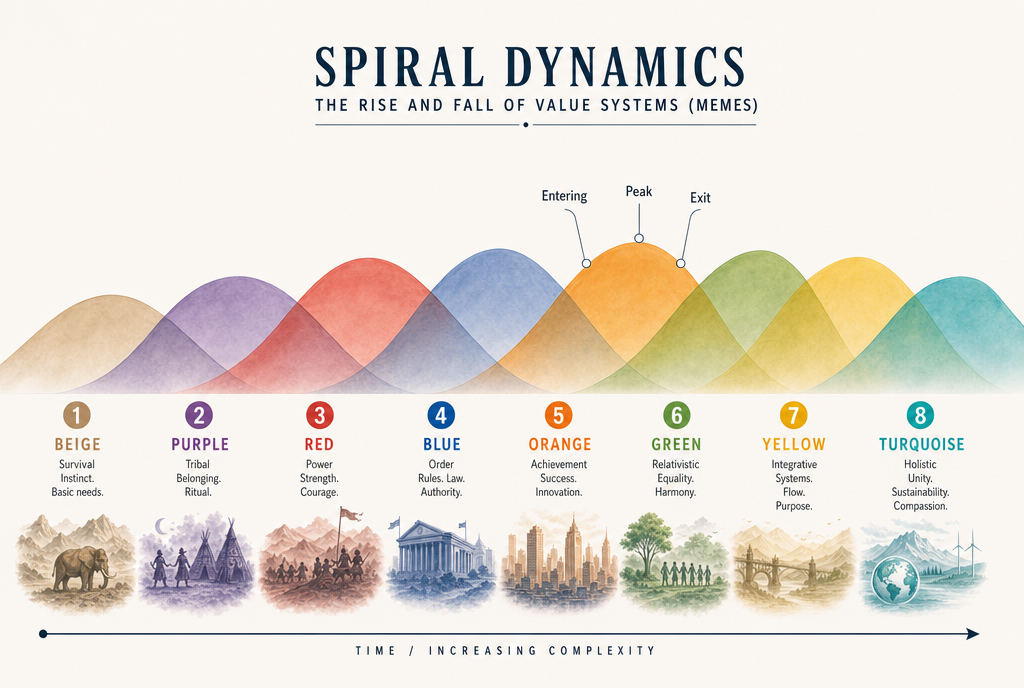
The life cycle of a meme
Spiral dynamics is always a process within a process, but there are no guarantees of movement or change. Neither change nor the preservation of the status quo is the rule. If there is imbalance and a disturbance of dynamic equilibrium, change happens. If not - it does not.
Principle 5: Movement along the Spiral goes hand in hand with a change in the level of complexity
Development along the Spiral goes from a lower level of complexity to a higher one; from the way of life needed to solve one set of problems to the way of life essential for solving the more complex problems of the next level of life conditions. Those who “fit” these conditions survive, whatever that takes - not necessarily “the most worthy,” whether physically, intellectually or emotionally.
This does not mean that every individual or group in a social system will be at the same phase of development. In reality, many will persist in inadequate behavior - malicious, dysfunctional, reducing society’s chances of surviving in the new life conditions. The mere fact that someone holds power gives absolutely no guarantee that their thinking keeps up with the level of complexity of the arising problems. It is often the other way around, and as one comedian said: “We have met the enemy, and he is us.” Very often a whole range of essential variables in the life conditions lies beyond the capacities of the leaders’ current set of memes. Revolutions often fail to deliver what their leaders promise, because in the act of rebellion the critical minds and resources needed to meet people’s expectations are destroyed. Until new memes are introduced or activated, one can expect only stagnation and, more likely, degradation.
How appropriate a given meme is - is a matter of point of view. Considering that such judgments depend on the position of the “judge” on the Spiral, it is not surprising that schisms arise in church and politics, that whole cultures rise and vanish, and that what for one person is a fight for freedom is terrorism for another. One man’s food is another man’s poison.
Although each new meme builds on the foundation of the previous ones and adds new factors of complexity, this does not happen in a predetermined or mechanical way. Different segments of humanity, living in different psychological spheres, will each move simultaneously toward their own future. This can always be explained after the fact, but cannot always be predicted. Although the connections between the outer life conditions and the memes within us shape our future, the factor of individual free choice keeps the dynamics alive and beyond purely rational thought.
Nevertheless, since our knowledge and experience are additive, the overall movement along the Spiral goes toward greater complexity. This includes four characteristics:
- The expansion of psychological space - toward more multifaceted personalities, more diverse organizational forms, and a much more complex habitat on the planet
- The expansion of conceptual space - toward larger views of things, wider zones of influence and longer stretches of time
- A progressive increase in the number of alternatives - toward more options for doing one and the same thing
- A progressive increase in the degrees of freedom of behavior - toward more possibilities of what to be, how to express emotions, and how to build relationships with others
It is somewhat like Intel’s line of microprocessors: from the once famous 8086 to the 286, 386, 486, Pentium and beyond.
Principle 6: Memes coexist within our “onion-like” profiles
If we cut a transparent Spiral from top to bottom, we would see an asymmetrical, onion-like profile of memes. This figure would show the strength of each colored layer in each specific area of life. Since memes are ways of thinking present in us, not types of us, and since we can think about many things - religion, family, work, sports, politics - it follows that we can hold several different ways of thinking, which may relate differently to different topics.
The meme set - Systems within People
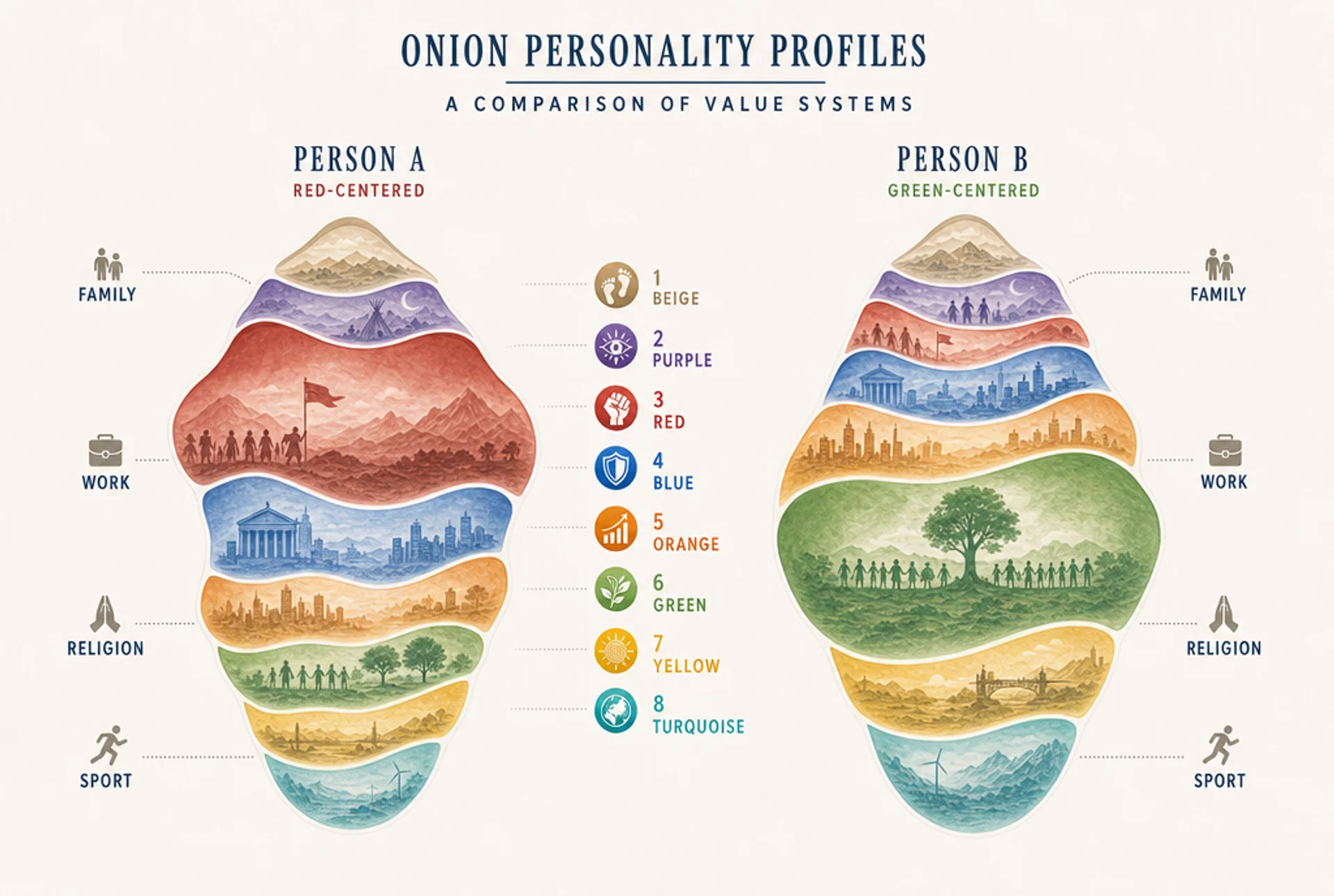
For example, these two profiles illustrate the relative strength and priorities of the eight deep memes in two different individuals. One is centered around the Red zone, the other more in the Green. Notice that the “Red” person thinks about religion through the Blue meme, and how close Purple comes to the surface in the area of home and family. On the other hand, the “Green” character activates Red when doing sports, and keeps a strong Orange in business.
If you could look at the great “onion” of all humanity, you would see millions of people at different levels of the Spiral at the same time. Although the population as a whole is somewhere in the middle, we constantly feel the blessings and curses of newly awakening memes. Television helps us here, even unconsciously - for example, every time we watch the evening news. All human problems “gather” here at once, in one place. Making sense of this tangle of events takes extraordinary mental work. Many of today’s young people suffer because they see the enormity of the problems of existence but have no key to solving them - a key which, of course, lies in the Spiral.
Principle 7: Memes on the Spiral group into tiers of six
For the moment, it seems that memes happily live in groups of six. The six systems of the First Tier of the human odyssey began at the animal level and cover our basic needs. They can be imagined as the first stage of a rocket, which separates when its fuel runs out. The next tier is like the second stage, which refines and corrects the trajectory roughly set by the first. And this refinement of the trajectory has no end, because the Spiral of human desires has only a beginning. The only exception is the exit into another dimension, beyond individual or extended egocentrism.
At present we are in the middle of the transition from the First Tier of six memes to the Second Tier of Spiral development. As Graves wrote: “After the animal fears of survival (Beige), the fear of spirits (Purple) and of other predatory humans (Red), the fear of transgressing the established order (Blue), the fear of one’s own greed (Orange) and the fear of social disapproval (Green), suddenly human consciousness finds itself free. Now, having released all its energy for cognition, the person focuses on themselves and their world (Yellow, Turquoise and so on).”
Besides this substantial liberation from all these kinds of fear, other important differences between the First and Second Tiers include a notable expansion of conceptual space, the removal of compulsion, the ability to learn a great deal from many sources, and the tendency to do more with less energy or fewer resources.
However, this process of growth is not necessarily pleasant. Every step of movement along the Spiral solves one set of problems and creates a new one. Today many people feel exhausted, having gone through three or four such painful transitions in their lifetime. Some first felt the influence of the Blue Law and were faithful followers of a noble cause. But then the pragmatism of Orange Ambition shifted their focus to individual materialistic goals and financial games. “Let others make sacrifices for the future, not me,” they began to say. Then, as these worlds of material success began to unravel, they started looking at their aging selves and others through the Green glass. “Surely this can’t be all there is to life?” they ask. “Right, a person isn’t even worth what you just said!” answers the clever but irritated and increasingly Red “generation X” all over the globe.
At the very time when the egocentric dragons of the Red meme and the demons of the Purple keep pursuing us and draining our energy at one end of the Spiral, people at the other end are also racking their brains in search of a way of being that would include self-respect and a caring attitude toward others in this complex world. How much we have to sort out in our hearts and minds when we think about the transition from the First Tier to the Second.
Yellow, the first of the “being” levels (rather than the levels of need), begins this Second Tier of memes by repeating the six basic themes of our history - survival once again, but now in the context of an information-saturated, highly mobile “global village.” The eighth (Turquoise) system is a repetition of the second, but an order of magnitude more complex - Mega-communities, Mega-trends and Mega-upheavals - embodying everything that happened in the First Tier. If this curious aspect of the “six-fold” theory proves true, then the ninth (Coral) will be a version of the third, Red level. This could have formidable consequences for geopolitics, the market and us as individuals. And meanwhile the story continues…
In conclusion, here is one more interesting and useful table connected with Spiral Dynamics.
Graves’ Management Model
| Meme | Ideal supervisor | Ways of learning | Communication strategies |
| Beige | Provider | Adaptation | Taste/Touch/Smell/Sight/Hearing. A simple appeal to the senses |
| Purple | Caring chieftain | Conditioning (Pavlovian) | Ritualistic. Reverence for strong figures, appeals to family, sharing, safety and magic |
| Red | Energetic, Strong, Big Boss | The butcher’s pain-avoidance principle | Direct, blunt manner of speaking; Strong, “What’s in it for me here and now,” The point. Cheap, “folksy” flash |
| Blue | External forces, The one right way, Consistent, Authoritarian | Spreading the truth with fear of failure | Respect for the “system,” appeals to tradition, self-sacrifice, length of service, patriotism and future stability |
| Orange | Success-oriented, Successful, Entrepreneur | The experimental trial-and-error method | Successful, high-status role models, Images of success, achievement, personal growth; “Refined” flash |
| Green | People-oriented, Enlightened, Friend | Observation, Empiricism | Warm, people-focused, unifying speeches. Supportive and “helping” images with employees and customers/clients |
| Yellow | Big-picture view, Serious partner | All systems | Functional information for everyone who needs to know. High-tech, Free access |
Developing A. Maslow’s concepts of the hierarchy of human needs, in the second half of the last century the outstanding psychologist C. Graves, after processing an enormous amount of experimental and statistical data, formulated a remarkable model of the system of human values. His work was developed by Don Beck and Christopher Cowan, who built on it a whole new direction in social psychology, which they called “memetics,” or Spiral Dynamics.
Today Spiral Dynamics attracts the lively interest not only of scientists, but of politicians, businesspeople, educators and others, who find it a convenient tool for analyzing and solving many practical problems connected with management and learning.
Based on excerpts from D.E. Beck and C.C. Cowan, “Spiral Dynamics - Mastering Values, Leadership, and Change”