Karpman Drama Triangle
This article was written by psychotherapist Yulia Golovkina. She explained the Karpman triangle and the way out of it so well and so visually that it is impossible to do it better - so here is her text, translated with care to keep her style, and her drawings.
The Evolution of Suffering into Delight
All people, without exception, want to live better than they live now. Even those who have everything still see a vector they want to follow. Because that is where development lies - and without development, living here on Earth is boring and meaningless. A poor waste of the great Divine Chance.
And it would seem - what could be simpler? Look at those who live better than you, learn from them, follow the good example, and development (and with it evolution, which brings more happiness than there was yesterday) is guaranteed!
Yet instead of this perfectly clear plan of action, people for some reason prefer to envy, to be jealous and to get irritated instead of learning. Thank God, not all of them. There are those who climb the ladder of evolution with confidence, and the theory below is for them.
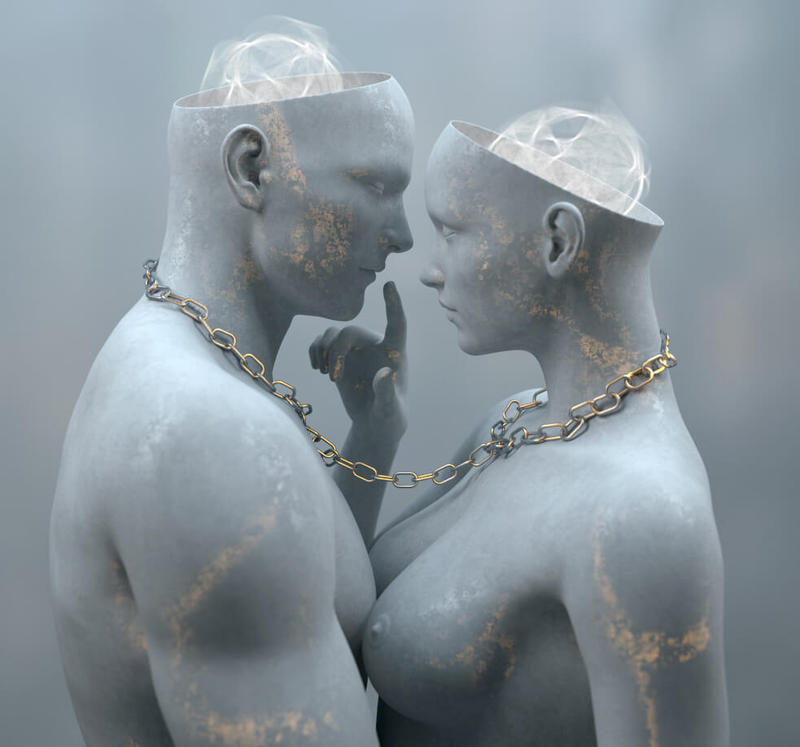
©Adam Martinakis
The starting rung of evolution was described by Karpman - it is his famous triangle:
VICTIM - PERSECUTOR - RESCUER
This rung is probably not even the zero rung, and certainly not the first. It is rather the “Minus First.” That is, a negative scale relative to where a person actually needs to go.
So, to begin with, the Minus First rung needs to be described as I see it now.
THE VICTIM
The Victim’s basic message is this: “Life is unpredictable and evil. It keeps doing things to me that I cannot handle. Life is suffering.”
The Victim’s emotions are fear, resentment, guilt, shame, envy and jealousy.
In the body - constant tension, which over time transforms into somatic illnesses.
The Victim is periodically sucked into depressions, when there is not enough courage to walk into an event that would produce an impression. Because an impression (what if it turns out to be a bad one?!) would force her to accept something, to integrate it into the personality. The Victim is not ready for that; her world is rigid and inert, and she refuses to budge in any direction.
In the Victim there is stagnation and immobility, although outwardly she may bustle like a squirrel in a wheel, forever busy and tired because of it.
But the Soul came Here, into the World, to develop - so immobility is not its choice. The Soul suffers, which is why in the Victim’s immobility, in her depression, there is no rest. The Soul demands movement from within; the Victim does not let it happen. And this struggle drains all strength.
“How tired I am of all this!” cries the Victim.
The Persecutor
He lives in fear, irritation, anger. He lives in the past
(recalling past troubles) and in the future (“anticipating” - in reality inventing - new ones), in the eternal desire to “lay down some straw” just in case. For him the world is a vale of suffering too, just as it is for the Victim. His basic message: “What if something goes wrong!”
Anger and fear are born from encroachments on his boundaries - and the World never tires of provoking! But at this level the personality is panically afraid of change, believing that no novelty can possibly be for the better.
In the Persecutor’s body - constant tension; he carries an Everest of responsibility for himself and his loved ones. He gets terribly tired of it, and blames his tiredness on those he controls. And takes offense on top of it: “They don’t appreciate my care!”
The Persecutor persecutes the Victim, “disciplines” her, forcing her to follow his prescriptions - and of course, for her own good! The Victim does not appreciate the care, and this is an eternal source of conflict, both internal and external.
And yet, in the “-1” triangle the Persecutor is the center where ideas are born and energy moves. How does it happen? The Persecutor gets frightened of something (the news on TV, for example) and starts motivating the Victim into active measures, so as not to perish tomorrow. The Victim does her best to follow the prescriptions, gets tired, suffers. She complains to the Rescuer, and he comforts her.
“How tired I am of taking care of you all!” cries the Persecutor.
The Rescuer
The Rescuer pities and saves the Victim, and sympathizes with the Persecutor. For the Rescuer, the Persecutor is also a Victim who needs understanding and recognition of his merits.
The Rescuer’s background feelings are pity, resentment (his rescue efforts were not appreciated), guilt (he failed to rescue), anger at the Persecutor. Resentment that his efforts were not valued.
The Rescuer pities the Victim because she is small, weak and cannot manage on her own. The Persecutor is a poor thing too, carrying everyone on his back… Someone has to support him - and who will, if not he, the Rescuer? Every rescue operation ends with the growth of the Rescuer’s EGO: “Without me you will all perish!” He proudly puts his hands on his hips and looks down on the Victim, the Persecutor and the whole world. This is his moment of triumph - one of the few positive emotions present in the first triangle.
In the body, however, - the same old tension.
“How sorry I feel for you!” is the Rescuer’s background thought and emotion.
The flow of energy is wrong.
The Persecutor - toward the Victim.
The Rescuer - toward the Victim and the Persecutor.
THE VICTIM GIVES NOTHING BACK - SHE HAS NOTHING!
There is no circle of energies, and energy leaks out of the system.
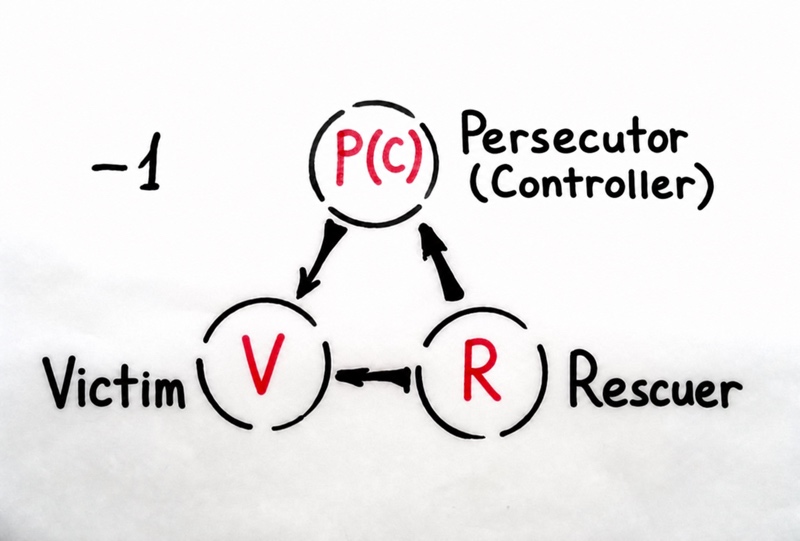
The Rescuer is far from understanding that changes - even tragic ones - always lead to development. They should be accepted and met halfway, not resisted.
In the “-1” triangle, relaxation tends toward zero. How can you relax when life is so dangerous? Something keeps happening all the time, knocking the ground from under your feet. At this stage people start getting sick early, surrendering themselves to external Rescuers (doctors). Scolding them with their Persecutor: “They treat us badly! The healthcare system is worthless!” And complaining with their Victims about how bad everything is.
In relationships with those close to them (in the family, for example), such people usually occupy one of the positions quite rigidly. For example, the Husband is the Victim (because he brings home too little money, and to muffle the guilt - he drinks). The Wife is the Persecutor, forever telling him how wrong he is. And when he gets drunk and feels sick, the wife may switch into the Rescuer and treat his alcoholism, or at least nurse him with pickle brine in the morning.
The husband also “walks” through the three subpersonalities. Mostly he is the Victim, but when drunk he may start terrorizing the household. And then “rescue” them, smoothing over his guilt with sweets and presents.
Or the mother of the family, who was always in the Persecutor or the Rescuer, falls into the Victim by starting to get sick. Nobody ever loved the Persecutor! And now (perhaps only in old age, when there is no strength left to resist illness) there is finally a chance to receive love. By arousing pity in the family around her.
The child who was in the Victim under the mother’s control transforms into the Rescuer (caring for the sick mother) and finally feels good about himself.
The Karpman triangle is a space of manipulation.
Being inside it, people chronically cannot say honestly what they actually need. Why so? Because they have been trained to “live for others” and are absolutely sure that others, in exchange, will live for them.
Pursuing your own happiness is something “the faith does not allow” - the faith in parents and educators: “surely they can’t all be wrong at once?!” They can… Parents and educators in childhood are harsh Persecutors. And consequently - manipulators; one never exists without the other. They themselves spin in this triangle of Suffering. They teach the child to be convenient, not free. From the point of view of a manipulating parent, a free child is a punishment from heaven. He keeps invading the parents’ life with the goal of “breaking everything in it” - or so it seems to them! And he always wants to eat, and pee, and walk, and talk at a time inconvenient (and it is always inconvenient!) for the parents. So for the Persecutor, a good child is one who sits in the corner and keeps a low profile. Asks no questions. Eats what he is given. Gets good grades. In short - creates no problems.
When does the first suppression happen? In that wonderful period when the child proudly says “I’ll do it myself!” and mom (or dad) does not let him. Eat by himself, for example. Because he will smear himself, stain his clothes - and who will clean up? Mom the Persecutor. She does not want to be the Victim who toils alone for everyone, so she prefers to control.
When the child grows and suppressing him by force becomes harder, she starts to manipulate: “Don’t do that, mommy’s heart aches!” The child pities his mom and, instead of realizing his own desires, begins to act as the Rescuer. This, of course, seems better than the Victim’s position, and he begins to feel his power: “Wow, look at me - I can make mommy’s heart ache or not ache! I’m mighty!” But he loves his mom, and so, gritting HIS OWN heart, he chooses to be good and not upset her. Time passes, he grows, and mom starts making claims: “Why are you so dependent?!” But how and where could he have learned independence, if all his ideas were cut down at the root?
Of course, the Persecutor Parent is not aware of this; he is sincerely convinced that he always acts in the children’s interest. Laying down straw, warning about dangers, so that the dear child does not wound himself against the World and does not collect bumps. But it is precisely the wounds and the bumps that give real experience which can be used later - while mom’s (dad’s) lectures give nothing except a sour taste and the desire to do the opposite.
All teenage rebellions come from the child’s desire to exit the Victim subpersonality. Even if the rebellion is “cruel and bloody,” with leaving home and breaking off relations - it is still a move toward life, toward evolution, not degradation.
There is no point in describing the manipulations of the “-1” triangle in detail - all the low-grade soap operas are about exactly that.
Honesty and sincerity in these spaces can only be dreamed of, because people are mortally afraid to show either their real needs or their actual feelings. Responsibility for one’s own life is out of the question here. Someone external is always to blame for misfortunes and negative emotions. The task is to find him and brand him with shame. Then the person feels that he is not guilty - and so he can keep considering himself good.
It is important to understand that the main task in these positions is self-affirmation through “earning” love.
The Victim - “I do it all for you!”
The Rescuer - “I do it all for you!”
The Persecutor - “I do it all for you!”
*** …and no one honestly and directly for themselves…***
They all earn love from each other, asserting themselves at the expense of those closest to them.
The sadness of the situation is that they will never earn love, because each of them is fixated on himself and does not see the others.
The humor of the situation is that all this happens not only in the outer world, but in the inner one too. Each person is his own Persecutor, and Victim, and Rescuer - and by the principle of likeness these figures are mirrored in the outer World.
People whose energies spin in the “-1” triangle (and there is pitifully little energy there!) have no chance of exiting it until they hear THEIR OWN true desires. What are they?
The Victim wants to break free and do what she wants - not what the Persecutor prescribes.
The Persecutor wants to relax, let everything take its course, and finally get some rest.
The Rescuer dreams that everyone will somehow sort themselves out, and he will no longer be needed. And then he too will be able to relax and think of himself.
And all of this, from the point of view of public morality, is rank egoism. But from the point of view of the specific individual, it leads to specific human happiness. Because happiness is where the realization of YOUR OWN quite tangible needs is.
It may seem that if the Victim, the Persecutor and the Rescuer turn inward instead of fighting in the outer world, that would be a more constructive path. That is when it is not the external enemies who get blamed, but the inner Persecutor who starts persecuting the inner Victim. “It’s all my own fault. I can never make the right decision. I am an irresponsible nobody, a weakling and a loser!” The Victim may resist feebly and then fall into depression, because she herself understands that this is exactly how it is. Then the Rescuer raises his head and says something like: “Others are even worse! And starting Monday I’ll begin a new life: I’ll exercise, wash my dishes, stop being late for work, and start complimenting my wife (husband). Everything will work out for me!”
The “new life” lasts a couple of days, or weeks, but there is not enough energy to bring the beautiful decisions to life, and soon everything slides back into the old swamp. A new cycle begins. The Persecutor persecutes the Victim: “Again, as always - you spineless, irresponsible, worthless…” And so on. This is that very internal dialogue that all the masters of meditation and other developmental practices so strongly motivate us to get rid of.
Yes, all the problems of external life are always solved inside first. It starts from the moment the decision is made to change the script. The problem of the person spinning in the “minus one triangle” is that he does not have enough strength to bring the useful and radical decisions to life.
Strength (resources) in the “minus one” triangle is scarce, because the triangle is closed in on itself and does not strive to go out into the external World (the World is dangerous and frightening, after all!). And a single personality has quite exhaustible reserves, which run out fast. Especially in the inner battles between the Victim, the Persecutor and the Rescuer. They actively fight each other, and it is no surprise that people get sick (the body suffers from these battles), losing energy and dying criminally early. Criminally in the sense that we are designed for a much longer term. We can live longer and happier - if we do not fall into the Triangle of Suffering. It is the real HELL. Not somewhere after death, but here and now. If we choose to be Victims, or to Rescue, or to Control.
The Karpman triangle is a “wounded child,” and it does not matter how old he is - 10 or 70. These people may never grow up at all. Of course, they rush about all their lives searching for a way out, but they rarely find it. To do that, one needs to rebel against one’s own settled patterns of behavior, to allow oneself to be “bad” in the eyes of others - “a heartless and ruthless egoist who lives only for himself” (a quote from the Persecutor’s favorite accusations).
This new way of living (for YOURSELF, not for others) really can destroy relationships with loved ones, create a pile of troubles at work and in the settled circle of friends and acquaintances. It can destroy the whole habitual life! That is why escaping from dreary but predictable safety takes a lot of courage. The person who is truly fed up with his joyless existence has a chance to find the strength. Through fear, guilt, aggression. By making SUPER-efforts, he can move to the next level. Because only there does HIS OWN life truly begin.
The second triangle, where there is already much less suffering and much more power over the World, is this:
HERO - PHILOSOPHER (THE UNBOTHERED) - PROVOCATEUR
You can only exit into the second triangle through polarity, when all three of the first subpersonalities transform into their opposites. Because, as we remember, the “-1” triangle is on the minus side of the scale. Crossing the “0” point, the minus changes its sign to the opposite.
What does the switch to the other polarity look like?
The Victim transforms into the Hero, the Persecutor into the Unbothered Philosopher, and the Rescuer into the Provocateur (Motivator).
This is the hardest thing on the path of evolution - to jump sharply from the “-1” triangle into the “+1”, because strength is scarce and inertia pulls you back. It is like turning a car around in the opposite direction at full speed (life doesn’t stop, after all!). On top of that, the whole environment is against the changes. It will cling to your arms and legs and stir up guilt in you - anything to keep you from breaking free. All of psychotherapy is devoted to precisely this process: healing the wounded child who lives inside the personality from the triangle of Suffering. And sometimes it is a path that takes a whole life.
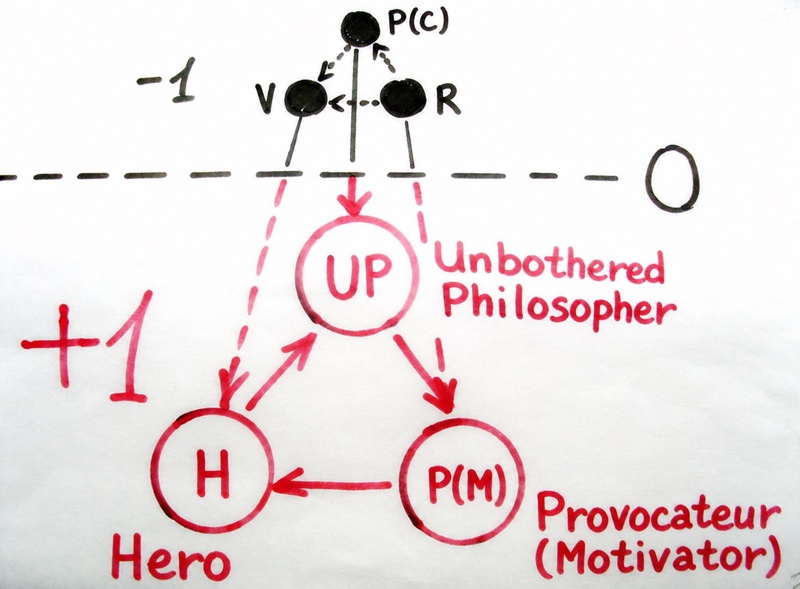
In the outer World, the transition to the next level becomes visible by these signs:
the person no longer falls for manipulations, but actualizes (voices and fulfills) his own desires. From now on other people’s goals do not seduce him, and even if they try to pull him in - actively and persistently, pressing the buttons of guilt, resentment, fear and pity - each time he asks himself: “And why do I need this? What will I get as a result? What can I learn if I do what is being offered?” And if he finds no win of HIS OWN in the offered idea, he does not get involved.
The main task of the Hero is the study of himself and the surrounding World. His background emotions are interest, excitement, enthusiasm, pride (if the feat succeeded). Disappointment and regret - if not. Boredom, if there is a long idle stretch. The Hero does not fall into guilt (and if that happens, it is a sign that he has regressed to the previous level and turned into a Victim).
I use the term “Hero” here because development really is a difficult undertaking - and yes, a truly HEROIC one. You constantly have to overcome your yesterday’s convictions, giving them up in order to go further. The “feat” can be in the outer World or the inner one - it makes no difference. Its scale makes no difference either. That is why at first glance you cannot always tell whether there is a Hero in front of you. But at the second glance it becomes clear, and the litmus test is the emotions he lives in as a background, and whether he “hangs” in his themes or keeps moving.
Rest, awareness and acceptance of the results of his actions happen when the Hero transforms into the Unbothered Philosopher. This is the polarity of the Persecutor from the “minus one” triangle. The Persecutor prescribes, persecutes, supervises the execution; the Unbothered Philosopher accepts ALL of the Hero’s actions, all of his results.
And bear in mind that far from all of the Hero’s feats in the surrounding World will be successful. In his unstoppable enthusiasm he wounds the surrounding World and gets wounded against it himself - sometimes quite painfully, emotionally and physically. In the thrill of exploring his capabilities he can make such a mess that his entire habitual environment has to creak and rebuild itself. So without a philosophical, unbothered attitude to his results - there is no way.
The Philosopher, dwelling in calm, in slowness, in observing from the side, is certain that everything that happens to him is for the best. We did not get the result - but we got the experience, which is sometimes more important. Here the attitude to the Ego transforms. The understanding comes that the Ego with its desires - “to eat tasty food, to sleep sweetly, and to live so as to make the neighbors envious” - must transform along the path of development. And that this path is thorny and bumpy is a normal phenomenon. The Ego may suffer badly in the process - also a normal phenomenon.
The Unbothered Philosopher accepts the suffering of his Ego, and this allows him to accept himself. Even if everyone around says “ugh, what have you done?”, his acceptance follows the principle: “if I did it, then I needed it - and it’s none of your business”.
The unbotheredness can be internal and unnoticeable, or it can be put on display and become an additional source of the individual’s pride. That is when his Hero carries a lot of protest teenage energy. And the presence of demonstrativeness can say a lot about his inner maturity. The more one wants to argue with the World for the sheer energy of arguing, the less mature the person is.
A mature Hero performs his feats not against someone (mom, the boss, the government, etc.), but because he himself wants to. His desires may coincide with the desires of society, or they may go against them. The higher he stands on the ladder of evolution, the less other people serve as his criterion.
The function of the Philosopher in this subpersonality is to analyze and draw conclusions. If the Hero does something and fails, the Philosopher analyzes his actions: “what was good, what was bad, what should be done so that tomorrow is better?” And if the theme still interests the Hero, he can repeat his action taking the conclusions into account. Or he may not repeat it, if it is no longer interesting. That depends on the degree of his stubbornness, and on whether the next accomplishment lies on the path his Soul has charted. If the needed experience has been extracted and digested, he can move on.
The third subpersonality, the center of ideas in this triangle, is the Provocateur (Motivator). (He is the polarity of the Rescuer.)
If the Unbothered Philosopher sees the picture as a whole, as if from above, the Provocateur is constantly searching for a vector. As if seeking a target in the World. He takes aim, choosing a suitable object for the Hero’s self-expression. And when he finds one, he fixes his attention on it. He can also be called the Motivator, because he not only teases the Hero in the style of “You chicken?”, but also shows what remarkable prospects will open before him if the feat is accomplished, what laurels he will be able to crown his head with, what honor awaits him.
The Provocateur does not analyze or account for his capabilities - that is the business of the Philosopher and the Hero himself. His task is to give direction. He is the most restless subpersonality of the three, because sometimes he does not let the Hero concentrate on one thing and see the plan through. There is a lot of childlike curiosity and excitement in the Provocateur; he is very mobile and chaotic. His favorite question is “What happens if…?”
Unlike the “-1” triangle, where the Victim can hardly resist the Persecutor, the Hero has a lot of freedom. He can always decline the Provocateur’s offer, or postpone it. If the personality is mature enough, the Hero does not rush at the first call. First he answers the question “What happens if…?” and, as far as he can, models the future situation, working out what difficulties he will face along the way. He prepares thoroughly, and then his actions have a better chance of success. With each new experience he climbs higher up the evolutionary ladder.
The Provocateur is permanently scanning the World, looking for territories not yet explored, and asking “What’s this - why haven’t we been there yet? It could be interesting there!” - and this is always about expansion, development and learning.
However, one should understand that development rarely goes both in breadth and in depth at the same time. So this stage is not yet an adult - it is an active, healthy teenager. His task is to go in breadth, studying himself, his capabilities and the World he can express himself in. His focus is on himself - and for this stage that is completely normal. It is too early to speak of attention to the World (including the people around). But his emotions and general state have already changed significantly compared to the “minus one” triangle - toward fulfillment and happiness.
Most people on planet Earth are, alas, in the “minus one” triangle. That is why Heroes, Provocateurs and the Unbothered are in short supply. And however egoistic they may look, theirs is a far healthier energy. A person firmly established in the “plus one” triangle never stops, and his life will always be interesting.
In the body here, tension rhythmically alternates with relaxation, and since there are far fewer suppressed emotions (ideally almost none at all - everything gets actualized immediately), there is no need to get sick. Yes, things happen to the body, but they come rather from careless handling - injuries, chills, overheating, exhaustion and the other side effects of “feats.”
Masculine and feminine energies
In the “plus one” triangle you can trace how the masculine and feminine energies show up in the subpersonalities. And unlike the “minus one,” they are not rigidly attached to the subpersonalities.
In the “minus one” (for comparison) things stand like this:
The Persecutor, even if it is a wife or a mother, is the masculine energy (acting, limiting, directing and punishing).
The Victim (submission, endurance, following instructions) is the feminine, even if it is a husband or a son.
The Rescuer can appear in two forms - masculine, if active deeds are performed for the sake of the rescue. Or feminine - if the Rescuer pities and sympathizes, surrounding the other with attention but doing nothing beyond that.
The Hero in the “plus one” triangle, manifesting as a man, performs feats of action: “If I do this, how will the World change, how will I change? What ELSE will I be able to allow myself as a result of my action?”
The feminine form of the Hero is the feat of acceptance. “If I find myself in an unfamiliar space, how will I survive there? Adapt? Settle in?” And the main question, showing how well the process went: “Will I be able to be happy in these new circumstances?”
If the individual has both subpersonalities harmoniously developed - the anima (the feminine part of the Soul) and the animus (the masculine part of the Soul) - then he has a chance both to GET where he is going and to ACCEPT what happens on the way and as a result.
The Unbothered Philosopher: the task of the feminine part of the Soul is to ACCEPT, without guilt, regrets or self-accusations, the consequences of one’s actions - including the change of the World under the impact of the Hero’s accomplishments.
And the masculine part’s task is to analyze the mistakes, draw the conclusions, “package” the experience so that it is convenient to use further. So that it becomes a platform for further change and growth.
The masculine part of the Provocateur says: “Do it!”
The feminine part of the Provocateur says: “Feel it!” or “Do you dare to feel this through?”
If only the masculine parts of the personality are developed, the individual will forever be rushing somewhere, excitedly scrambling from rung to rung. Never letting himself “get used to things and settle in,” master the conquered space - which is precisely the feminine function. If only the feminine parts are actualized, he will lead an active inner life, attentively feeling into all its aspects. But there will be no visible movement forward.
Then again, for a person in the “plus one” triangle such a path is hardly possible - that is meditation, and his energies are not balanced enough to stay motionless. The distances are calling him, the World spreads out before his feet, and he wants to walk it, to comb it with his own feet far and wide. No time for meditation!
Why is the Hero - the opposite of the Victim - the First rung of the ladder of Evolution? Here it is useful to turn to history and mythology. Heroes are the children of Gods and mortals. Their path and their task is the accomplishment of feats. Their main goal is to become Gods. And some of them (in Greek mythology) were raised to Olympus by the Gods. What does this mean in a modern reading?
A person is born, and his task is to become a God. For this he must first become a Hero - that is, the one WHO ANSWERS THE CALLS OF FATE. He may get lucky, if he is persistent, brave and attentive. That is, if he calls up the qualities that will help him be impeccable enough to reach the goal. Who always reaches the goal? Who makes no mistakes and never misses? “He does it like a God” - THERE IS SUCH A HUMAN saying. Only GOD makes no mistakes and ALWAYS achieves success. That is, the Hero strives to become a God, to become like his parents - not the humans, but the GODS - the Archetypes. That is, the FINEST models of human beings.
The transitional stage between the Victim and the Hero is the stage of the Adventurer. He answers the calls of fate far more willingly than the Victim. And he has many features of the hero - boldness, courage, the ability to endure hardship and draw conclusions - so it is very easy to confuse him with the Hero. But there is one essential difference between them. The Adventurer counts on luck; the Hero counts on himself. For the Adventurer, victory is a stroke of chance or the result of a clever scheme; he likes to work less and receive more. To take more than he gives. He devoutly believes in the luck that falls on one’s head out of nowhere, and considers it his task to catch it by the tail. He suspects that an adequate exchange of energy exists, but thinks it is for suckers. Or (at a higher level) for the calculating, honest and precise - among whom he does not count himself, though secretly he respects and envies them.
The Adventurer tries to swim in the waters where the big fish live, risking being eaten by them. But he understands perfectly well that the main resources are there, and with a certain deftness a solid jackpot may come his way. Besides, there is always something to learn from large-scale figures.
The female adventurer is a high-flying courtesan who ruins her lovers without a care for what she gives them in return.
The lives of adventurers are full of escapades; they live in their own world and enjoy the respect of neither Heroes nor, all the more so, Winners. Victims don’t favor them either, but that is mostly out of envy. Yet adventurers have charm to spare. By trading on it, one can hold out at this stage for a whole lifetime, become the prototype of a literary hero (Ostap Bender), and even enter history like Count Cagliostro. But for inner development it is better to quickly renounce the philosophy of luck and free cheese, and to understand that the honest exchange of energy with the environment has never been canceled. And in the end it is far more reliable.
The people living in the next triangle are mature adults. And they are the ones who hold 90% of the resources, although there are no more than 10% of such people in the World. This is the “+2” triangle.
Winner - Contemplator - Strategist
The Hero from the “+1” triangle transforms into the Winner, the Unbothered Philosopher into the Contemplator, the Provocateur into the Strategist.
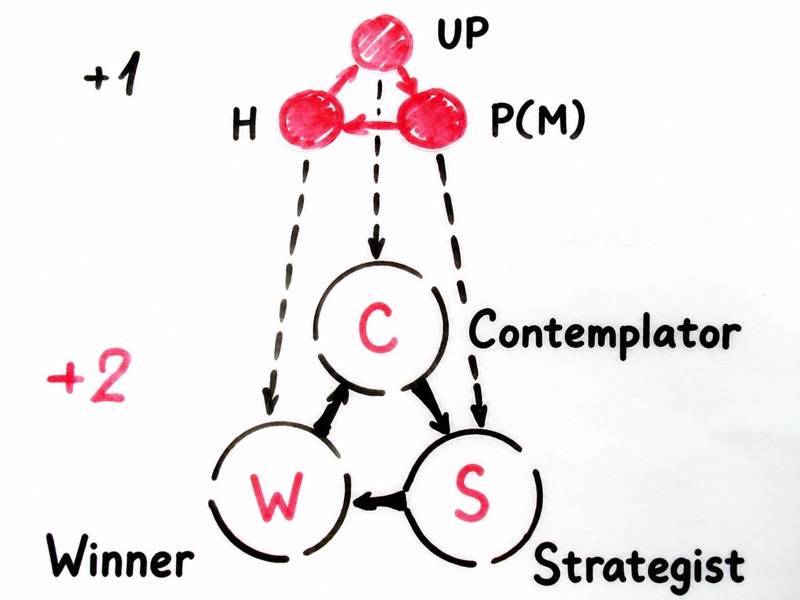
The base emotions of the Winner are inspiration and enthusiasm.
The base emotion of the Contemplator is grace, peace. And only at this stage can a person meditate, finally freeing himself from the internal dialogue. No extra effort is needed for this - it stops by itself, because at this stage of development there is nothing left to worry about. In the World of Winners there is order; nothing needs improving, everything is already good. But there is a great deal of energy here, and it does not stand still for long. The Contemplator gives birth to an idea (it is in the Contemplator that the center of ideas lies in this last triangle) and sends it to the Strategist.
The Strategist feels the joy of having such a wonderful pastime - thinking through an interesting project - and satisfaction with himself (when he comes up with it). Joy, pleasure, inspiration are his base emotions.
In the “plus two” triangle a person creates out of generosity; there is no place here for scarcity and economizing, or the fear that follows from them. In the environment where Winners live, the World is beautiful but not stopped. It develops, and the Winner’s task is to be an active developing factor.
The Winner usually has several directions of realization: “A talented person is talented in everything” - that is about him. But this happens not because the Winner does not want to put all his eggs in one basket (that is the philosophy of the Hero, with leftovers of the Persecutor’s fear from the “-1” triangle).
In the worlds of Winners there are enough eggs and there always will be; they grow on trees and lie about underfoot in the garden of paradise. The desire to create comes from the desire to play. It is the nurtured and cherished desire of the Child who came into the World to become a God for his World.
He has no need to criticize or judge himself. He has already studied himself and the surrounding space. He knows it the way a child knows his set of blocks. He invents what to build from them and creates new structures out of the enthusiasm of “What else can be done here?” He rejoices in the process and marvels at the results.
The masculine form of the Winner is action and the creation of the New.
The feminine form is the same, but in the inner world. A Winner of the feminine type (not necessarily of the female sex!) is a Wizard, a Magician. He does not need to act in the outer world; he creates the New in the inner one, and it materializes. How and why? Much has been written about it, but it can only be understood in practice, and only at the level of Winners. For them the formula “To receive something, it is enough for me to WANT it” is not magical in the least - it is perfectly mundane. That is how they live.
The Winner enjoys the process of creation, both inner and outer. Enjoyment of life, of the movement of energy, of the remarkable fact that a human being truly is the Center and the Creator of his World - that is the main pathos of this level.
By the way, the Winner is by no means necessarily an oligarch. In everyday life he can be quite modest. The point is not the quantity of resources at all, but the true understanding that there is ALWAYS ENOUGH of them. And if something is needed, it materializes - the needed chains of events line up, the needed people appear by themselves and offer help. From the outside it looks mystical; inside their own lives, Winners treat it as a normal, ordinary phenomenon.
The Contemplator is the feminine subpersonality. She accepts the World, is fertilized by it and gives birth to ideas.
The Strategist is the masculine subpersonality. He directs, develops the plan, points out where to get the necessary resources.
At this level tension is dosed and regulated instinctively. There is no need to get sick - if the specific individual matches the archetype completely, that is, if there are no unworked themes from the past.
In reality, of course, it is far from always so. A person successful and realized in creative work or business may “sag” in relationships, or the other way around.
For example, a Winner may fall in love with an “unsuitable” woman, and if his relationships are not in balance, his instinct will fail him - this woman will be a Victim. He may start “rescuing” and “educating” her, trying to pull her up to his level. And… he automatically falls into the “-1” triangle, where yesterday’s Victim starts “disciplining” him, actively demanding further tokens of attention. If he accepts this (because - “Lo-o-ove!!!”), he himself turns into the Victim, and yesterday’s Victim into the Persecutor. This is what folk wisdom calls “climbing onto someone’s shoulders and dangling your feet.”
Another example from the life of a Winner who has not worked through his hungry childhood. Having gained access to enormous resources (having become, say, the president of a country), he will start “raking it in”; the suppressed fear will not let him stop this process and start working for the good of society. Such a plot, of course, ends sadly. Sooner or later a pyramid being dug up from one side collapses. The Winner becomes a Victim forced to flee the country in disgrace, and the people, who were in the Victim’s position, become the Persecutor.
The most important question is: “How does the Hero differ from the Winner? How can one move to the next level - the level so many yearn for?”
The Hero is occupied with himself - his adventures and his reactions. For him the World is a set of gym bars on which he studies his capabilities and pumps up his weak functions. The Hero is fixated on himself, although outwardly he may look benevolent and full of love. But he is a cocoon out of which a realized being will be ready to emerge - when it is ready. He may, of course, spend his whole life preparing and in the end never be born. Or he may be born and bring the World a new theory explaining how everything works here; or a new way of communicating; or a well-working system of energy production; or something else.
What is a Realized Being? It is an entity that CREATES - that makes the World. The main difference between the Winner and the Hero is Creation, the changing of the World.
Not out of the desire:
-
to rescue,
-
to show off,
-
to get rich,
-
to have fun,
-
to entertain others (and get their attention)…
…but out of the desire to Create. That is, to do what has not been done before him. This is a quality of God manifested in a human being. To Make for the sake of Making. Feedback from people is not particularly interesting.
One can give it, or one can stay silent. The Winner makes something in order to materialize his energy, not so that those around him will be delighted. Delight and approval - that feedback is needed by the Hero. The Winner himself knows that what he has made is good. Because he cannot make anything bad. His feminine subpersonality dwells in total acceptance - “everything that happens is good” - and other people’s criticism cannot shake it.
At the Winner’s level, the feminine and masculine subpersonalities (anima and animus) are in Sacred Marriage. The inner Woman leans on the actions of the Man and admires them. The inner Man feeds on the admiration of the inner Woman. And even if the whole World is against him, he totally approves of himself and can sincerely fail to notice the condemnation of others (unlike the Hero and the Unbothered Philosopher, in whom there is a large share of demonstrativeness: “you don’t love me, but I don’t care!”).
The Winner in this sense is closed on himself, and so autonomous that he is able to sustain himself.
And of course, by the principle of likeness, Winners attract those men and women in the outer World who mirror their animus or anima. That is why relationships in the “plus two” triangle are far happier than anyone else’s. And not at all because they “buy love,” as it seems to those looking up from the Victim, or even from the Hero. Their personal mirror reflects what is - HAPPINESS in acceptance and realization.
A woman in the Winner state can claim any man. A Winner will recognize her as his own, and a Hero will be flattered. As for a Victim - he will simply faint from happiness.
A man in the Winner state can also approach any woman of this World, and it is hard to refuse him. Instinct at this stage is so developed that he does not even want to approach those with whom things would go badly. So - every shot hits the mark. And this is not about hunting or trophies.
A Winner and a Winneress are a King and a Queen in whose kingdom everything is in order. The people prosper, the economy flourishes, and for Heroes there is always room for a feat. And if both have worked through all their themes, neither slides down from their personal Olympus.
Winner-Hero is a less stable pair. The Winner will always look at the Hero with a certain measure of appraisal. The Hero will perform feats (because it is his stage, and it must be completed!) in honor of his beloved. But a feat is a feat precisely because it can end in failure. And the Hero will tumble head over heels off Olympus. Or the Winner will take a step down and start walking her feminine Hero’s Path, ACCEPTING the failure of her chosen one.
Winner-Victim is a nonviable pair. If the Winner is a man and the Victim is a woman, this is the archetype of the slave girl taken into the palace for her beauty. Her task is to walk the feminine Hero’s Path, accepting EVERYTHING in her Winner - including his infidelities, rudeness, aggression and the other currents of his emotional states. If at some point she “catches a star,” feeling her power, she may start “disciplining” her man and putting on a “sad face” or an open scandal, signaling that she lacks attention, a mink coat, a trip to a resort, sex or guarantees. He may put up with it for a while, until his feelings cool. Then the pair falls apart.
The scenario beloved by soap operas will not work. Alas! Two adjacent levels can still come to an agreement, but jumping across a level is hard. Almost impossible. One would need too good a karma (for the Victim) or too bad a karma (for the Winner) to even out and stay happy.
By the way! Bear in mind that in our earthly conditions the leveling most often happens at the expense of the stronger one. That is, he becomes less strong, not the other way around. Gravity works in spiritual processes too, so sliding down is easier than climbing up. It is another matter that the stronger one in the pair (the Winner or the Hero) will sooner or later come to their senses and draw the lessons from their falls much faster than their Victim partner will.
From this point of view it is interesting to analyze the tale of Cinderella. It is so attractive to Victims because they see hope for themselves in it. From servant girl - to Princess. Awesome!
In reality they understand the tale incorrectly, for Cinderella was not a Victim at all. She was walking her feminine version of the Hero’s Path, fulfilling all her stepmother’s orders responsibly and - most importantly - without complaint. For her, the stepmother was not a Persecutor but a Provocateur, motivating her to learn and acquire new qualities. When the Path was completed (Cinderella passed the trials and gathered the necessary experience), helpers appeared (the fairy godmother) who helped her move to the Winner’s level and become a princess. The fairy also acted as a Provocateur, offering her to break the order established by the stepmother, and Cinderella agreed to take the risk (masculine heroism - the deed).
If Cinderella had really been a Victim, then instead of doing her tasks quickly and well she would have spent an enormous amount of energy on resistance, discontent and complaints - and a Rescuer would have come to her aid (the same fairy, for example, or the prince himself). A Rescuer always demands a reward and transforms into a Persecutor. The fairy could have made Cinderella “serve out” her gratitude and would have turned into that same stepmother. And the prince would have put her into a golden cage. And that would have been an entirely different tale…
A woman Winner and a man Victim - everything is exactly the same. But society is less tolerant of this, and the man is called a gigolo. If, however, the man is a Hero who wins the love of his lady (a Winner), then he is a knight performing feats. And that is a different matter entirely; this archetype is approved by society, and rightly so. He may even become a Winner on the strength of his accomplishments and in the rays of her love. Such cases are known.
In couple relationships the law is relentless: in the “-1 triangle” - suffering. In the two upper ones - different kinds, but HAPPINESS. If a character from the lower triangle appears in a pair, it is the path of conflict. Clearly, the conflict is needed by the characters of the play - it is their Hero’s Path. If a Winner meets a slave girl and falls in love with her, and she starts acting up - “Why didn’t you beat the carpet, and why are you late from work” - then he faces a great temptation: either to start accepting it (the feminine Hero’s Path), or to get rid of her like an annoying fly. And every time this is a Decision, and a very specific vector of development. There are no ready answers here, because we are all different and we all need different things. It should be remembered that the Winner too may have his own “unfinished business” - lessons he did not complete in his time as a Hero. And in exactly that place Life will keep provoking him until he works through the block that obstructs the flow of energies.
Interpersonal relations between partners from different triangles are built by the same laws as the romantic ones. For partners (friends, colleagues) to be comfortable with each other, they must match by the principle of likeness (complementarity) of energies.
Who is complementary to a Victim? Another Victim, a Rescuer, or even a Persecutor. They will always find something to talk about and will understand each other perfectly. Each time it will be a different dialogue in emotional coloring, but they will speak the same language.
But for a Hero and a Victim things are already harder. Imagine, for example:
The Victim: “Everything is bad, my life is so hard!”
The Hero: “Everything can be changed, you just need to pull yourself together and stop whining and complaining.”
The Hero speaks of what he himself does, and it works for him; he shares sincerely - but the Victim may see the Persecutor’s energy in him, take offense and end the dialogue.
If it continues nonetheless, one may hear, for example, lines like these:
The Hero (continuing): “Go to the gym - you’ll have more energy, you’ll feel better.”
The Victim: “What are you talking about? I don’t have money even for essentials - what gym?”
Next the Hero may fall into the Rescuer and offer to lend money, at least for the first month of training. This is a worthless option, because the Victim will not return the money, and it is doubtful she will use it for its intended purpose. And even if the debt is repaid, it will be without much gratitude - which is exactly what the Rescuer always counts on. None of this is likely to strengthen their friendship.
The Hero can, staying inside his own triangle, switch on the Unbothered Philosopher and say something like: “Yes, it’s hard - but you still have to climb out somehow, right?” In this case he leaves the Victim to decide for herself what to do, treats his friend as an adult, with respect and faith in his strength. From the outside, though, this may look like indifference.
There is one more subpersonality the Hero can use for talking to a Victim. It is the Provocateur. What can the Provocateur answer to the Victim’s complaints? Something like: “Yeah, old friend, with a life like yours I see no other way out - only the noose”… and he will ironically explain where to get a good sturdy rope that will not fail at the crucial moment. This, of course, can wound the Victim deeply - but strangely enough, it is almost the only way to pull a person out of the Karpman triangle. The Provocateur delivers it crudely but honestly: “either die, or change your life”.
For the Victim it is hard, almost unbearable, to communicate with a Hero unless he falls into the Rescuer. And the Hero finds the Victim uninteresting. He is burdened by a relationship where telling of his successes only upsets the Victim more (she will certainly not rejoice for her friend!), while listening to her complaints is boring and pointless.
Out of love for people, the Hero may continue this communication (especially if it is a friendship of many years). But there will be success and benefit for both only when the Victim voluntarily recognizes the Hero as her teacher. And, using his advice, begins - at her own pace - to climb out toward a brighter future.
The same goes for Winners and Heroes. Either the Hero learns from the Winner and considers this communication an honor, or it is doomed. Even if the Winner and the Hero once sat at the same school desk.
Can one be born a Winner?
No, one cannot. Even if a person is born into a family of Winners, he must still walk his own Hero’s Path. Trying to jump straight onto the throne is like being a 3-year-old child and waking up at the age of 20. Impossible. There is too much to learn, and the gap here is enormous. No one will do a person’s work for him.
However, in a family of Winners a child has every chance of becoming a Winner too, because the parents will not suppress his energy and initiative. They will have enough resources (intellectual and physical) to give him tasks that will quickly raise him to a higher level. Nor will they lay claim to his “loyalty” to family values - they do not need it. They value their own freedom highly, and so they are ready to grant it to others.
Can one avoid becoming a Victim?
To answer this question, we also need to describe the ZERO triangle.
The zero level is found in small children and in a very small number of adults who neither fell into the Victim nor dared to go into the Hero. It looks like this:
Impulse - Activity - Evaluation
At this level the Ego has not yet formed, which is why the names are formulated as qualities, not as personalities (not the Doer, but the Doing).
Energy goes from the Impulse to the Activity, and the Evaluation of results is only forming, since thinking itself is forming.
At the tender age of up to 3 years the child lives in the primal paradise and does not yet know how to divide the World into “good” and “bad.” Any urge, passing no censorship, is instantly turned into action. Emotions flow freely, and there is no suppressed energy in the body. There is no time to ponder the results of one’s actions - and nothing to ponder with: the conceptual apparatus is not yet formed. So the child easily changes the direction of movement and action: from a butterfly - to a block - to a toy car - to mom - to an apple, and so on.
If he falls, pricks himself, gets burned and receives the other slaps of the environment, his Evaluation remembers it and puts a checkmark on the dangerous spot, to mark where he should not climb in the future. This is how the initial gathering of experience happens - the primary study of life. According to some data, in this period a person receives 90% of all knowledge about the World he will have to live in.
The parents (caregivers) in this period provide the child with the conditions for survival and growth (ideally). Their task is not to take over the role of the Evaluation, which would make it impossible for the child to gain his own experience. If they make decisions for him and announce them directively - “don’t climb, you’ll fall!.. don’t drink that, you’ll catch a sore throat… chew properly or you’ll choke…” and so on - they form in him a fear of life, which later leads to the Zero level developing not into ”+” but into ”-”, and forms the Persecutor.
Cutting off the child’s free activity in this period - and later, after age 3, when he begins to master more complex actions by imitating adults - forms the Victim.
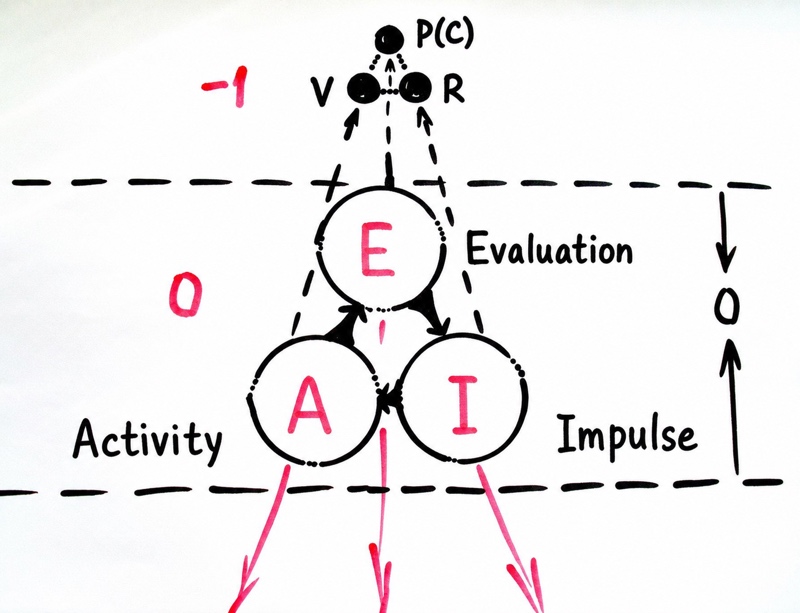
If the upbringing is right, the child, as a self-organizing system, will himself lead his way from one experience to the next. The person goes into the ”+” and begins his Hero’s Path, gradually complicating BY HIMSELF the tasks he has to deal with. And he has every chance, by the age of his prime (30-40), to unfold his potential completely.
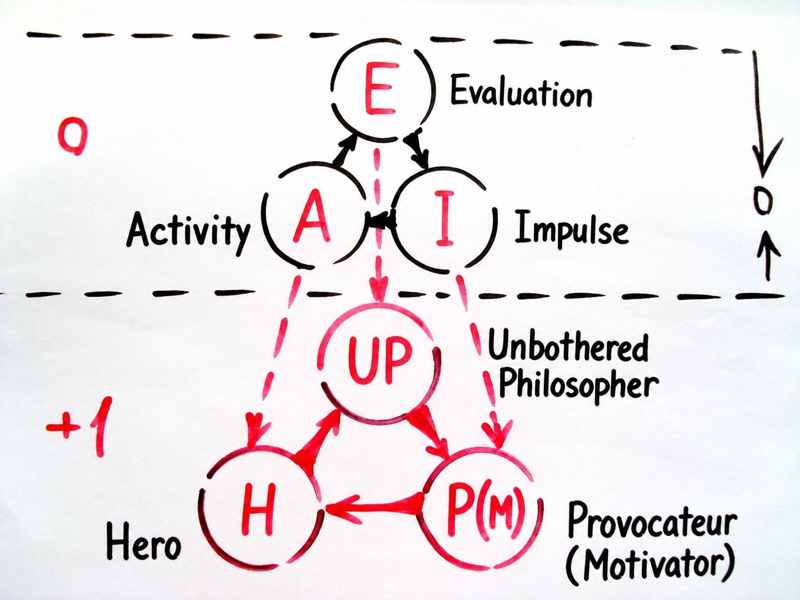
The first Karpman triangle is like a virus passed from generation to generation, when yesterday’s children, raising their own children, repeat the same mistakes: they restrict, control and manipulate.
Intuition
With intuition in the Karpman triangle (at the “-1” level) things are quite bad. The individual mistakes the voices of his inner fears (that is, of the Persecutors and Rescuers) for “insights”. Intuition here is rather the construction of negative scenarios, the whipping up of fears, or the laying down of straw. The goal of a person at this level is SURVIVAL, which means total defense. He clings hysterically to his boundaries, and his intuition serves that.
At the level of Heroes things are already better. The signals are the more precise, the better the subpersonalities of the triangle have been worked through. In each of them intuition plays its role, making it possible to move toward the goal in the best way. By the way, in the Hero’s case “best” does not necessarily mean most comfortable. Rather the opposite: the best way is the one with more experience in it, which means it will definitely not be comfortable. After all, the Hero’s goal is the KNOWING of himself and the World.
The Winner’s intuition is excellent. He knows exactly what to do and when, trusts himself and rarely makes mistakes. His “gut feeling” does not let him down. The strategic goal here is CREATION, which comes not from the desire to make life easier, but from the surplus of energy.
A company in the 1st triangle: a harsh boss (the Persecutor), the subordinates are Victims, the trade union committee is the Rescuer. The company (or organization) works poorly; resources are scarce. When the boss (the Persecutor) is out of sight, the subordinates stop working, or work carelessly, without a spark.
A company in the 2nd triangle: a Hero at the head, Heroes as department leads. Fierce competition inside and out. Victims work in the lowest positions, and until they exit into the “1st” triangle they have no chance of promotion.
A company in the 3rd triangle: a Winner owns the company, characters from the 2nd triangle hold the key posts. For example, a Hero as head of production, a Provocateur as creative director. Philosophers (with almost no admixture of the Unbothered) as analysts, HR, accounting. The Winner can also make use of Victims and Persecutors. Persecutors - security; and Victims, as always, get the dirtiest and lowest-paid work.
For diagnostics, it is worth scanning your own close circle - who is there? (work, family, friends) If it is Victims, Persecutors and Rescuers, then your life is probably not a very happy one, and it is time to do something about it. Even if you feel you stand a head taller - your environment always reflects you, and no one else.
If it is Heroes, the Unbothered and Provocateurs - your life is interesting and demanding, full of trials and drive… And Winners don’t read articles like this one - things are already “smashing” for them!
And finally, the last level, which cannot go unmentioned. It is the Sage (the Enlightened One).
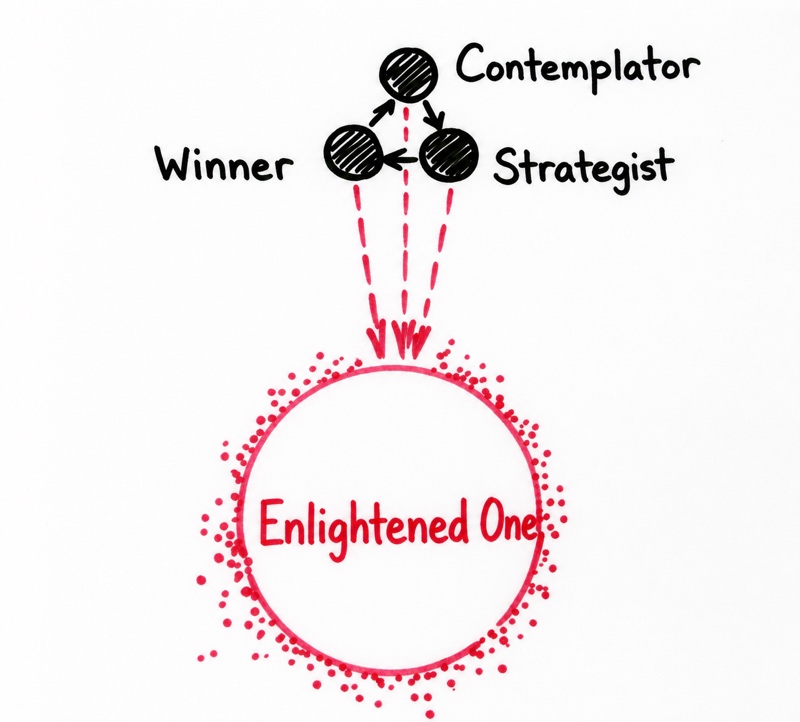
At this level there are no longer subpersonalities with divided functions. Because there are no goals of existence. Existence itself is the goal. The Sage merges with the World, feeling its perfection, because at this level there is no longer any notion of “good” and “bad” - and hence no striving to move from one to the other.
He may, of course, be engaged in some external activity, and from the outside Heroes will take him for a Hero, and Victims for a Victim. In reality, inside his consciousness there is total stillness and grace. Everyone feels good in his presence; he influences the state of the World he lives in, and of the people who happen to be near.
The Sages-Enlightened (there are few of them, unfortunately) become known even if they do nothing for it. The light they radiate attracts other people, who come to warm themselves and receive grace simply by being near.
This is a person realized completely, who has accepted and manifested his Divine essence. The Sage can change the World without lifting a finger - only by changing his inner state. But most often he does not interfere with the course of events, because he sees the perfection of the World that others do not see.
There is no point hurrying there - and no way to hurry. This state comes by itself, as a natural stage, or never comes at all. There is a version that “we’ll all end up there” - if not in this life, then in the next. And each of us has our own pace.
Directions of movement at the different stages
The Karpman triangle - movement toward the lesser evil, “from bad to less bad”;
The Zero level - movement is chaotic and still non-judging. The goal is unconscious, but it exists - the gathering of experience;
The Hero’s triangle - movement “from bad to good”;
The Winner’s triangle - movement “from good to better”;
The Sage - no need to move; THERE IS THE STATE OF BLISSFUL PEACE; the individual returns to the Zero (non-judging) level, but consciously.
Happy climbing up the ladder of evolution!