Spheres of Life
Sometimes life seems to stretch us in different directions: here is you and your body, here are the people close to you, here is work and the team, and here is the country, the news, the whole planet - and everything needs attention, and there is not enough of it.
“Spheres of Life” is a simple map for sorting this out: to look at life as circles of different scale and learn to calmly move attention from one to another without losing sight of the rest.
This map has three dimensions - three different ways to draw circles around a person. The first is closeness: who is closer to you, who is further away. The second is scale: from you alone to the whole world at once. The third is how much of what is happening is in your hands at all.
Now one by one.
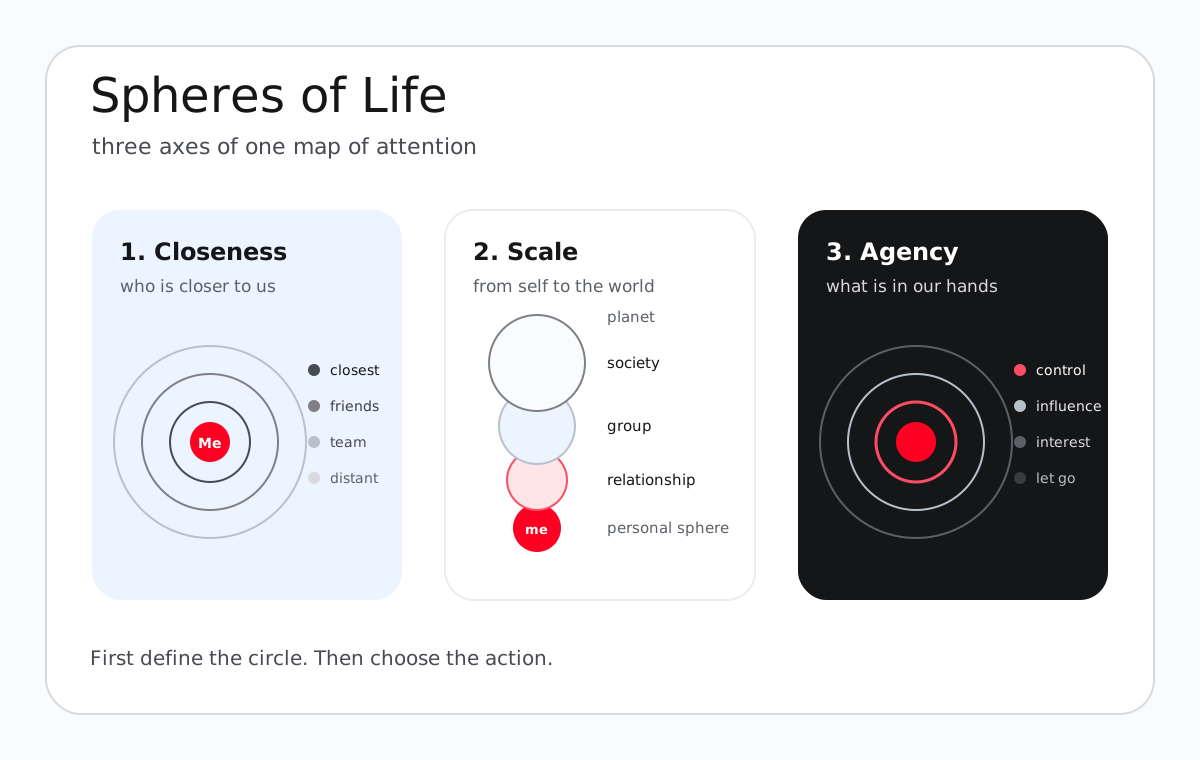
If you combine these three dimensions, you get not a flat “wheel of life” anymore, but almost a 3D map of attention.
Not “how to live correctly,” but much more concrete:
- who really is the close circle here?
- what scale are we looking at right now?
- what can be controlled here, what can be influenced, and where are we simply burning our nervous system?
The first axis - closeness
Around every person there are circles of closeness.
In the center - the person themselves. Then the first ring: those who are really near. Usually family, partner, children, closest friends. Then the next ring - friends, parents, important colleagues, the team. Further - acquaintances, neighbors, former colleagues, classmates, people from the past. On the farthest rings there may remain former partners, the dead, enemies, public figures, imaginary interlocutors with whom the inner dialogue still continues.
This sounds strange only until you start checking it on yourself.
A person who has died may long be physically absent, yet take up an enormous place in the inner life. A former partner may be formally “former,” but psychologically sit almost in the center. And a living child nearby may get less attention than an abstract audience one wants to please.
This is no longer theory. This is diagnostics.
This axis has an unpleasant but very useful law: we tend to overvalue the far circles and undervalue the near ones.
A person we rarely see often appears better, smarter, subtler, more interesting. We fill in the emptiness between meetings ourselves. And the one who is nearby every day is visible with all the socks, the tiredness, the irritation, the requests, the imperfections and the living human noise.
The far gets idealized. The near gets devalued.
Many strange distortions come from this. One can spend years investing attention in random people, followers, distant acquaintances, exes, imaginary future partners - while giving the near ones the leftovers. One can remember better what someone said on the internet than what one’s own child asked for yesterday. One can save energy for the outer circle and be harsh exactly where tenderness is needed.
But the main return almost always comes from the near circles.
In a hard moment we are lifted not by the people who liked us once at a conference. And not by the audience that pressed “like.” But by those who are really near.
Sometimes physically. Sometimes simply near on the inside. But near.
So the first check is very simple: where does the attention go? To those who are close, or to those who are far away but somehow took the center?
The second axis - scale
The second axis is the scale of the sphere.
You can look at life from the level of a single person: body, health, name, belongings, personal tastes, sleep, food, your own state.
You can rise to the level of a relationship: what is happening between two people, what dynamic is forming, who gives what, who takes what, where the connection is alive and where it is only habit by now.
You can look from the level of a group: the family as a system, the team, the company, a club, a project. Here something appears that is bigger than the sum of the participants. A group has its own rhythm, its own culture, its own rules, often never said out loud.
Further - society: the country, the culture, large groups, shared norms, laws, the market, the historical moment.
Further still - the planet, ecology, species, the closed system of Earth.
And the scale can be expanded almost endlessly: stars, the galaxy, the universe, everything that exists at once. To some, such levels will seem too cosmic. But the very ability to raise and lower the scale is already useful.
One of the most practical things in this model is the ability to rise one sphere higher.
If you look at a conflict only from the personal sphere, it looks like “I was not heard,” “I was hurt,” “I am right.” If you rise to the level of the relationship, you can already see not only yourself, but what is happening between you. If you rise to the level of the group, you can see how this fight affects the family, the team or the shared work. If you rise even higher, it sometimes becomes clear that the problem is not as central as it seemed inside the moment.
This does not mean devaluing the personal.
The personal sphere does not disappear inside the big one. It is included in it. It simply stops being the only one.
The most common mistake is to sacrifice one sphere for another and pretend they are not connected.
Work ate the body - then the work itself starts to sag. The family ate the personal sphere - the person disappears, and with them disappears the living presence in the family. Public anxiety ate the closest relationships - home becomes empty, although the person is perfectly informed about the state of the world.
The spheres are nested in each other. You cannot cut one out without consequences for the rest.
The third axis - agency
The third axis answers the most sober question: what here is in our hands at all?
It is convenient to distinguish four zones.
The zone of control - what can be done directly. Your own action, your own decision, a text, the calendar, sleep, a reaction, the choice to speak or stay silent, to open the file or close the tab.
The zone of influence - what can be influenced, but with no guaranteed result. Relationships, children, the team, partners, clients, negotiations. You can talk, offer, create conditions, but you cannot live another person’s life for them.
The zone of interest - what matters, but barely responds to personal action. Exchange rates, the weather, political decisions, the global market, other people’s opinions, the behavior of people we do not know.
Outside of interest - everything that is not worth spending psychic energy on at all. A huge area that is better not dragged into the head without need.
The zone of control is the smallest and the most expensive. It requires presence, decisions, responsibility and constant participation. That is why there is less of it than we would like.
But it is real.
And if you live from it, it gradually expands. Not magically. Simply what yesterday was only a zone of influence can, with time, become a skill and move into control. Today you can only ask. Tomorrow you already manage to negotiate. Today the task is frightening. Tomorrow there is a procedure, and it gets done calmly.
But the opposite happens too. If you do not use your control for a long time, it shrinks. What used to be an action turns into dependence on others. What used to be a decision turns into anxiety. What could be done with your own hands becomes an eternal “I don’t know what depends on me.”
This axis is especially important in a world that constantly pulls attention into the zone of interest: news, forecasts, crises, other people’s opinions, catastrophic scenarios. All of this may be important. But if you live only there, the zone of control starts to empty out.
And without the zone of control we will not be able to do anything that matters.
Where the three axes meet
The most interesting part begins when the three maps are laid on top of each other.
For example, there is a close person. This is the first or second ring of closeness. But in a specific situation we may have only a zone of influence, not control. You can talk, be present, offer, negotiate. But you cannot force another person to be happy, mature, grateful, healthy or ready for a conversation.
If closeness is confused with control, rescuing begins, and pressure, and a lot of resentment.
Or there is a piece of world news. The scale is huge - society, the planet, maybe the future of civilization. But personal agency is most often small: it is a zone of interest or a very distant zone of influence. If you react to it as if it were your personal sphere and your zone of control, the nervous system gets the command “save the world immediately.” But personal action here is often not enough. And then, instead of action, anxiety appears - which influences nothing, but takes the energy away.
Or there is work and the team. The team can be a close circle in the professional sphere. But a good leader does not turn the team into an extension of their own zone of control. If the leader holds everything in their own hands, the team does not grow. People follow instructions, but do not learn to see the situation, make decisions and take responsibility.
Mature leadership begins where you delegate not only tasks, but the right to intermediate decisions, resources, responsibility and the right to make mistakes. The ideal team is not the one where the leader is in every action. It is the one where the function of leadership exists even when the leader is not sticking out in the center of every process.
The same logic maps well onto designing AI agents.
A bad agent either does nothing without a constant push, or gets into everything: I will decide it all now, I will rewrite it now, I will understand the person’s life better than they do. A good agent understands its spheres.
What is in its zone of control: find the file, assemble a draft, check the structure, offer options, run the checklist.
What is in its zone of influence: help the person see the solution, ask the right question, hold the context, not let the important thing be forgotten.
What is outside its zone: deciding for the person, publishing without permission, replacing human choice with itself, pretending it knows the person’s life better than the person does.
This is not only about agents.
A person, too, often breaks exactly where they try to live with the wrong authority.
A practical filter
If we simplify it all the way, the model can be used as a filter of three questions.
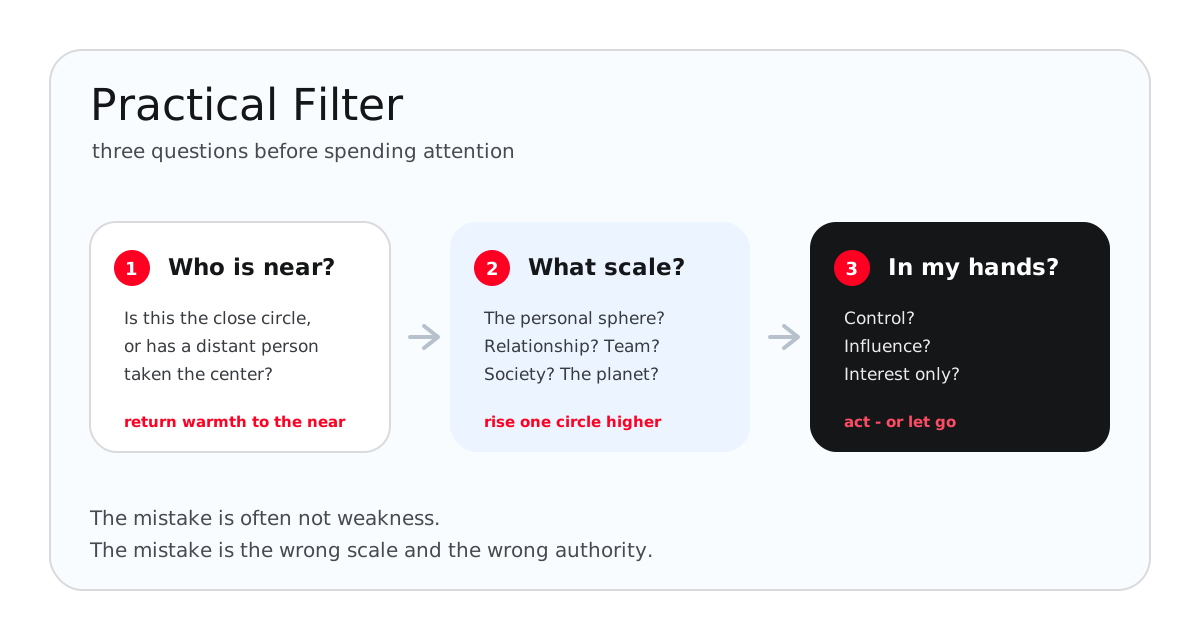
1. Who is near here?
This is the question about closeness. Is the person, situation or image we are thinking about really on the near ring? Or has someone distant been dragged into the center - an ex, a random person, an imaginary one, a public figure?
And the other way around: haven’t those who are really near been pushed out to the far ring?
2. What sphere are we looking at right now?
This is the question about scale. The personal sphere? The relationship? The family? The team? Society? The planet? No need to jump straight into space. Sometimes it is enough to rise just one circle higher.
A fight in a couple looks different from the sphere of the relationship.
A conflict in a team - from the sphere of the shared work.
Personal tiredness - from the sphere of the body, not from the sphere of “I can’t cope with life.”
3. What can really be controlled here?
This is the question about agency. Can you act directly here? Influence? Only watch? Or simply close the tab and go to sleep?
The last option is underrated.
Where to use the spheres of life
This model is especially useful in moments when everything has gotten mixed up.
When you want to save those who did not ask.
When the news has captured so much attention that nothing is left for the people close to you.
When distant people seem wonderful, and the near ones irritate.
When work has eaten the body, the home and the relationships - and then started to crumble itself.
When an employee, a partner, a child or an AI agent does something wrong, and the first reaction is to take the control back.
In every such place you can stop and lay the situation out along the three axes.
Not to become a perfect person. We won’t, so we can relax :-)
But to at least see where exactly the scale got confused.
Very often the problem is not that a person “can’t cope.” It is that they are trying to control the zone of interest, ignoring the near circle, and looking at a personal problem from such a distance as if the fate of the galaxy depended on it.
Sometimes life starts to come back together when attention returns to the right sphere.
To those who are near. To what is really in our hands. To the scale that the body and the psyche can hold right now.
And everything-that-is can wait.
Sources
- Flemming Funch - the spheres of life model and the vertical scale from the individual to the all-encompassing sphere.
- Radislav Gandapas - “The theory of the inner circle”: circles of closeness, moving people closer and further, leadership through the near ring.
- Sergey Semikin - the article “Zones/circles/spheres of influence, control and interest” on Habr, building on Stephen Covey, Bodo Schäfer and William Dettmer.